Sunday, 22 February 2026

14,000 satellites in orbit above Earth: more to come - too many ?


Too many satellites? Earth’s orbit is on track for a catastrophe – but we can stop it

Astronomer’s view of a star obscured by streaks from Starlink satellites. Rafael Schmall/Wikimedia Commons, CC BY
Gregory Radisic, Bond University and Samantha Lawler, University of Regina

On January 30 2026, SpaceX filed an application with the US Federal Communications Commission for a megaconstellation of up to one million satellites to power data centres in space.

The proposal envisions satellites operating between 500 and 2,000 kilometres in low Earth orbit. Some of the orbits are designed for near-constant exposure to sunlight. The public can currently submit comments on this proposal.

SpaceX’s filing is just the latest among exponentially growing satellite megaconstellation proposals. Such satellites operate with a single purpose and have short replacement life cycles of about five years.

As of February 2026, approximately 14,000 active satellites are in orbit. An additional 1.23 million proposed satellite projects are in various stages of development.

The approval process for these satellites focuses almost entirely on the limited technical info companies have to submit to regulators.

Cultural, spiritual, and most environmental impacts aren’t taken into account – but they should be.

The night sky will drastically change

At this scale of growth, the night sky will change permanently and globally for generations to come.

Satellites in low Earth orbit reflect sunlight for about two hours after sunset and before sunrise. Despite engineering efforts to make them less bright, truck-sized satellites from many megaconstellations look like moving points in the night sky. Projections show future satellites will significantly increase this light pollution.

In 2021, astronomers estimated that in less than a decade, 1 in every 15 points of light in the night sky would be a moving satellite. That estimate only included the 65,000 megaconstellation satellites proposed at the time.

Once deployed at a scale of millions, the impacts on the night sky may not be easily reversed.

While the average satellite only lasts about five years, companies design these megaconstellations for nearly continuous replacement and expansion. This locks in a continuous, industrialised presence in the night sky.

All this is causing a space-based “shifting baseline syndrome”, where each new generation accepts a progressively more degraded night sky. Criss-crossing satellites become the new normal.

And for the first time in human history, this shifting baseline means kids today won’t grow up with the same night sky every previous generation of humanity had access to.

A comic showing Earth satellites at different points in time.
The Conversation, CC BY-SA

Houston, we have a ‘mega’ problem

Concerns over the sheer volume of proposed satellites come from many sides.

Scientific concerns include bright reflections and radio emissions from satellites that will disrupt astronomy.

Industry experts also note traffic management and logistical concerns. There’s currently no form of unified space traffic management in the same way that exists in aviation, for example.

Megaconstellations also increase the risk of Kessler syndrome, a runaway chain reaction of collisions. There are already 50,000 pieces of debris in orbit that are ten centimetres or larger. If satellites stopped all collision avoidance manoeuvres, the latest data shows we can expect a major collision in 3.8 days.

Major cultural concerns abound, too. Satellite light pollution will negatively impact Indigenous uses of the night sky for longstanding oral traditions, navigation, hunting, and spiritual traditions.

Launching so many satellites uses up vast amounts of fossil fuels, damaging the ozone layer. After the satellites have served their purpose, the end-of-life plan is to burn them up in the atmosphere. This poses another environmental concern – depositing vast quantities of metals into the stratosphere, causing ozone depletion and other potentially harmful chemical reactions.

All this feeds into legal concerns. Under international space law, countries – not companies – are liable for harm caused by their space objects.

Space lawyers are increasingly trying to understand if international space law can actually hold corporations or private individuals accountable. This is especially important as the risk of damage, death or permanent environmental damage grows.

We can no longer ignore the gaps in regulation

Currently, the main regulations concerning satellite proposals are technical, such as deciding which radio frequencies they will use. At national levels, regulators focus on launch safety, lessening environmental impacts on Earth, and liability if something goes wrong.

What these regulations don’t capture is how hundreds of thousands of bright satellites change the night sky for scientific study, navigation, Indigenous teaching and ceremony, and cultural continuity.

These are not traditional “environmental” harms, nor are they technical engineering concerns. They’re cultural impacts that fall into a regulatory blind spot.

This is why the world needs a Dark Skies Impact Assessment, as proposed by space lawyers Gregory Radisic and Natalie Gillespie.

It’s a systematic way to identify, document, and meaningfully consider all the impacts of a proposed satellite constellation before it goes ahead.

How would such an assessment work?

First, evidence must be gathered from all stakeholders. Astronomers (both amateur and professional), atmospheric scientists, environmental researchers, cultural scholars, affected communities, and industry all bring their perspectives.

Second, it’s essential to model any cumulative effects of the satellites. Assessments should analyse how constellations will change night sky visibility and skyglow, orbital congestion, and the risk of casualties on the ground.

Third, it will define clear criteria for when unobstructed sky visibility is critical for science, navigation, education, cultural practice, and shared human heritage.

Fourth, it must include mitigation pathways such as brightness reduction, orbital design changes, and deployment adjustments to lessen harm. This should include incentives for using as few satellites as possible for a given project.

Finally, the findings must be transparent, independently reviewable, and directly tied to licensing and policy decisions.

It’s not a veto tool

A Dark Skies Impact Assessment doesn’t prevent space development. It clarifies trade-offs and improves decision making.

It can lead to design choices that reduce brightness and visual interference, orbital configurations that lessen cultural impact, earlier and more meaningful consultation, and cultural considerations where harm can’t be avoided.

Most importantly, it ensures that communities affected by satellite constellations aren’t finding out about them after approval has already been granted and bright lights crawl across their skies.

The question is not whether the night sky will change – it’s already changing. Now is the time for governments and international institutions to design fair processes before those changes become permanent.The Conversation

Gregory Radisic, Fellow at the Centre for Space, Cyberspace and Data Law; Senior Teaching Fellow, Faculty of Law, Bond University and Samantha Lawler, Associate Professor, Astronomy, University of Regina

This article is republished from The Conversation under a Creative Commons license. Read the original article.

Friday, 20 February 2026

Climate change - impact of changes in Earth's upper atmosphere


Dramatic changes in upper atmosphere are responsible for recent droughts and bushfires: new research

Pixabay/Pexels, CC BY
Milton Speer, University of Technology Sydney and Lance M Leslie, University of Technology Sydney

Over the past decade, southern Australia has suffered numerous extreme weather and climate events, such as record-breaking heatwaves, bushfires, two major droughts and even flash flooding.

While Australia has always had these disasters, our research reveals these new extremes are the result of dramatic climate-driven changes in the upper atmosphere above Australia.

Eight to ten kilometres above the ground, the fast-flowing jet stream air currents have shifted further southwards, dragging rain-bearing winter weather systems away from Australia’s southern coastline.

This means southern Australia has experienced at least 25% less annual rainfall and is currently gripped by a continuing drought. Our findings should be a wake-up call for governments, primary producers and residents of some of Australia’s largest cities: the hotter, drier weather is here to stay.

Drought in the south, wet in the east

Southern Australia comprises the coastal and adjacent areas in the south of the continent, stretching about 4,000 kilometres from Perth to east of Melbourne. This region is home to ten million people, or about 35% of Australia’s population.

The two most recent droughts in southern Australia were the Tinderbox drought, from 2017 to 2019, and the present drought, which has not been named. It began in 2023 and is continuing into February 2026.

Drought is primarily a meteorological, or weather-related, phenomenon. It is defined by intense rainfall deficiencies over three months or longer, which severely impact agricultural production, water supplies and ecosystems.

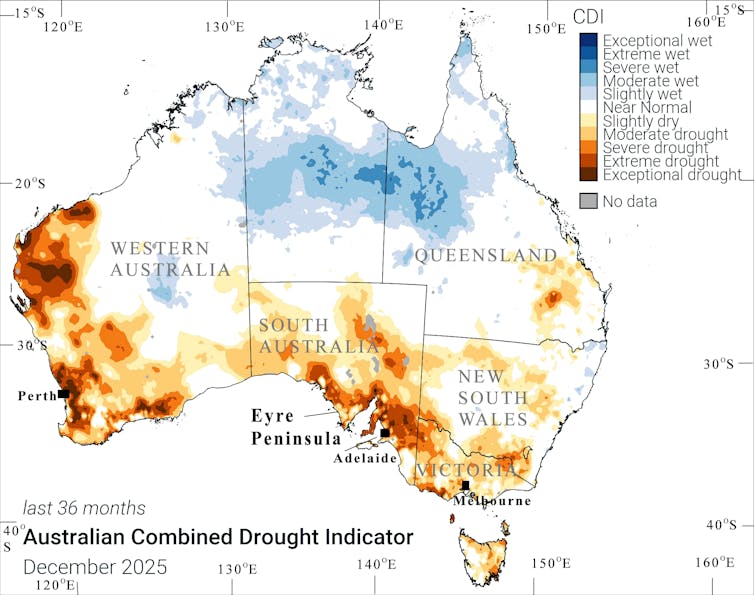
Notably, six of the past ten years were dry, tipping much of southern Australia into drought. In marked contrast, eastern Australia, including Sydney and Brisbane, experienced moderate to extreme wet conditions, including flash flooding. The map below shows drought in southern Australia in 2023–25.

A map of Australia showing areas of drought between 2023 to 2025.
CAPTION HERE. Australian Combined Drought Indicator Map, CC BY-ND

The meteorological factors that drive drought in southern Australia, and the shift from dry to wet conditions in eastern Australia, can be explained by shifts in the upper atmospheric jet streams. These are fast-flowing, narrow air currents high in the atmosphere, about 8–10km above Earth.

Major changes to the jet streams

Our research reveals dramatic changes to the jet streams in the Australian region, particularly in the past decade. Put simply, jet streams are fast-moving belts of westerly winds in the upper atmosphere. They steer cold fronts and low-pressure systems across southern Australia, from west to east, determining rainfall and temperature patterns.

In the Australian region there is a subtropical jetstream over northern Australia and a polar jet stream in the mid-latitude westerly winds south of Australia. Historically, the jetstreams have steered the rain-bearing systems over southern Australia.

We discovered the subtropical jet stream, which brings rainy weather systems, has shifted about 10 degrees of latitude (roughly 1,000km) southwards towards the pole, since 2015.

This shift has caused traditional rain-producing weather systems to track south of the continent, completely missing southern Australia. Our previous research comparing 1965 to 1992, and 1993 to 2020, also showed the jet streams had shifted towards Antarctica.

This shift is due to climate change from increased greenhouse gas emissions that continues to warm the oceans and atmosphere. As the world keeps warming, the jet streams will be pushed further poleward.

Hence the jet stream changes are responsible for both the current drought, and the Tinderbox Drought (2017–19). Each drought was caused by below-average winter rainfall from April to October. And the greatest relocation of Australian region jet streams occurred in the past decade.

Where were the droughts?

Between 2023 and 2025, almost all of southern Australia experienced a serious to extreme lack of rain, causing severe to exceptional drought conditions. Drought has affected Melbourne, Adelaide and Perth, straining existing water supplies.

Brief winter rainfall in July 2025 provided some local relief, however, the impact was short-lived. Recently, the summer months from December 2025 to February 2026 brought extreme heat and record low rainfall. Consequently, drought continues into January and February 2026. In striking contrast, parts of eastern and northern Australia received record rainfall and flash floods.

In southern Australian, coastal and inland areas, river systems and dams are experiencing greatly reduced water supplies. This reflects the continuing long-term impacts of global warming.

In Adelaide, three extremely dry years have reduced water inflows to reservoirs. The city’s single desalination plant quadrupled its output from January last year, to meet demand. Perth has experienced a long-term rainfall decline since 1970. It has two desalination plants and is building a third.

After briefly recovering during the La Niña years from 2021 to 2023, Melbourne’s dams are at their lowest levels since the Tinderbox Drought. Melbourne received well below average rainfall through to October 2025. Its desal plant was activated briefly in 2022, and was reactivated in April 2025. A second Melbourne plant is planned, but will take almost a decade to complete.

Primed to burn

Droughts and low winter rainfall means southern Australia is very susceptible to bushfire. Heatwaves and dry vegetation at the beginning of this summer brought catastrophic bushfire conditions, bolstered by dry, westerly wind changes. This caused catastrophic bushfires in southern Australia. More than 430,000 hectares have been burned in Victoria.

These conditions should be a jolting wakeup call. A possible El Niño, or warming climate pattern, later in 2026 is likely to worsen existing drought conditions in southern Australia. Melbourne’s water storage is at 70% capacity and is in danger of falling much lower. Southern Australia needs to ready itself for a hot, dry year.The Conversation

Milton Speer, Visiting Fellow, School of Mathematical and Physical Sciences, University of Technology Sydney and Lance M Leslie, Professor, School of Mathematical And Physical Sciences, University of Technology Sydney

This article is republished from The Conversation under a Creative Commons license. Read the original article.
Tuesday, 10 February 2026

Monitoring of nuclear tests


In the Australian outback, we’re listening for nuclear tests – and what we hear matters more than ever

ANU Media
Hrvoje Tkalčić, Australian National University

Tyres stick to hot asphalt as I drive the Stuart Highway from Alice Springs northward, leaving the MacDonnell Ranges behind. My destination is the Warramunga facility, about 500 kilometres north – a remote monitoring station I’ve directed for the Australian National University for nearly 19 years, and one of the most sensitive nuclear detection facilities on Earth.

When I started exploring Earth’s inner core in 1997, I had no idea my calling would lead me here, or that I’d spend years driving this highway through the red expanse of the Australian outback.

And today, as the New START treaty curbing the US and Russian nuclear weapons programs expires, the work we do in the red centre has become more important than ever before.

A giant telescope pointed at Earth’s centre

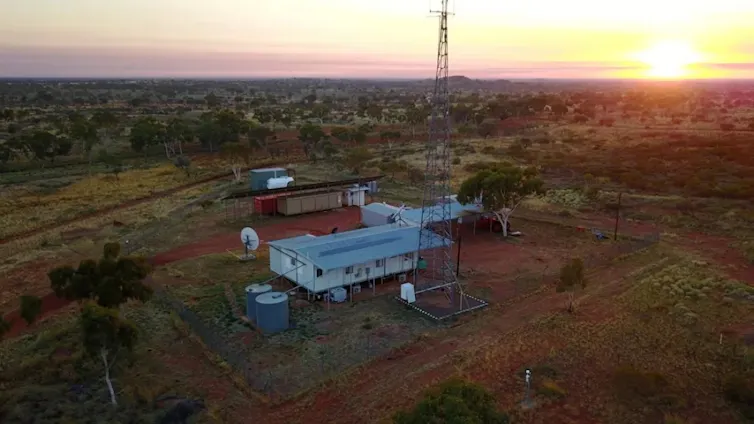
Located 37km southeast of Tennant Creek – or Jurnkkurakurr, as it’s known in the local Warumungu language – Warramunga consists of what might generously be called a demountable building, surrounded by sensors lined up across 20km of savannah, covered by red soil and long, white spinifex grass.

The facility operates two sophisticated arrays. One consists of 24 seismometers detecting vibrations through Earth, the other eight infrasound sensors picking up ultra-low-frequency sound waves inaudible to human ears.

When North Korea detonated its largest nuclear device in September 2017 – about 7,000km away – our instruments captured it clearly. Warramunga detected all six of North Korea’s declared nuclear tests, and our data was among the first to reach the International Data Centre in Vienna.

Aerial photo showing buildings in a red, scrubby landscape.
The Warramunga station is near Tennant Creek in the Northern Territory. Nearmap, CC BY

The geological stability and remoteness mean we detect events that might be masked elsewhere. When a wild brumby gallops past our sensors, we pick it up. When a nuclear bomb is tested on the other side of the world, we definitely know about it. We can distinguish it from an earthquake because of the different kinds of vibrations it produces.

Warramunga detects more seismic events than any other station in the global network. With multiple instruments in a carefully designed configuration, far from the coast and human activity, you have something like a giant telescope pointed at the centre of Earth.

An unusual partnership

Warramunga’s story began in 1965 when Australia and the United Kingdom jointly established it for nuclear test detection during the Cold War. In 1999, it was upgraded and later certified as a primary station in the Comprehensive Nuclear-Test-Ban Treaty Organization’s International Monitoring System.

The CTBTO, headquartered in Vienna, operates a global network of more than 300 facilities designed to detect any nuclear explosion anywhere on Earth. Australia hosts 21 of these facilities – the third-largest number globally.

But Warramunga is unique. It’s operated by a university on behalf of both the CTBTO and the Australian government, located on Warumungu Country. The location of sensors was determined in consultation with Traditional Owners to ensure the instruments would not interfere with sacred sites.

The Research School of Earth Sciences at the Australian National University in Canberra has managed Warramunga for more than 50 years, and we still do.

Life at the station

The station requires constant attention. Two dedicated technicians drive from Tennant Creek to the array each morning. By the time they arrive, the Sun is already high above the red land across which the array’s elements and termite mounds are spread.

They keep a careful watch on the world’s earthquakes and explosions, enduring extreme heat, dust, flies, fires, floods, thunderstorms and the occasional visit from wildlife. They ensure data flows continuously via satellite to Vienna.

After one infrastructure reconstruction, we found two large goannas wrapped around a seismometer, having decided to spend their nights in the firm embrace of our equipment. You don’t learn about this kind of challenge in Vienna’s United Nations offices.

Metal devices on red soil
Detectors at Warramunga. Hrvoje Tkalčić, CC BY

From Canberra, I coordinate between the on-site team, the Australian government, and our partners at the CTBTO. At least once a year, I make the drive up the Stuart Highway to Warramunga, checking equipment and discussing challenges with the technicians.

I also meet regularly with colleagues at the United Nations in Vienna. Managing this facility means bridging two worlds: the practical realities of maintaining sensitive equipment in a harsh environment and the international diplomacy of nuclear verification.

Why it matters now

For more than 30 years, the world has observed a de facto moratorium on nuclear explosive testing. The last US test was in 1992. Russia’s was in 1990.

This norm has been crucial in limiting nuclear weapons development. Verification systems such as Warramunga make this possible, because would-be violators know any significant nuclear explosion will be detected.

But this system faces its greatest challenge in decades. In October 2025, President Donald Trump announced the United States would begin testing nuclear weapons “on an equal basis” with Russia and China.

Days later, President Vladimir Putin directed Russian officials to prepare for possible nuclear tests. If this moratorium collapses, it opens the door to a new era of nuclear arms racing.

This is when verification becomes most crucial. The CTBTO’s network doesn’t just detect violations – its existence deters them. If the world knows a country has carried out a nuclear test and tried (but failed) to hide it, the testing country will face political consequences.

A hidden contribution

Warramunga’s data also helps researchers understand earthquakes, study Earth’s deep interior, such as the solid inner core, and track phenomena from meteorite impacts to Morning Glory clouds – extraordinary atmospheric waves travelling 1,400km from Cape York, first scientifically documented with Warramunga’s infrasonic array in the 1970s.

What strikes me after nearly two decades is how this unique partnership represents a remarkable example of academic institutions contributing directly to global security.

Few people realise that a university research school operates one of the world’s most crucial nuclear verification facilities. It’s an arrangement that brings together fundamental scientific research with practical obligations under international treaties – a model for how researchers can engage with pressing global challenges.

As nuclear rhetoric intensifies globally, the quiet technical work in the Australian outback gains new significance. Nuclear test monitoring is essential to deter would-be nuclear nations – and that’s a mission worth maintaining, even from the remote red centre of Australia.The Conversation

Hrvoje Tkalčić, Professor, Head of Geophysics, Director of Warramunga Array, Australian National University

This article is republished from The Conversation under a Creative Commons license. Read the original article.