Showing posts with label Science - space - orbits. Show all posts

Sunday, 22 February 2026

14,000 satellites in orbit above Earth: more to come - too many ?


Too many satellites? Earth’s orbit is on track for a catastrophe – but we can stop it

Astronomer’s view of a star obscured by streaks from Starlink satellites. Rafael Schmall/Wikimedia Commons, CC BY
Gregory Radisic, Bond University and Samantha Lawler, University of Regina

On January 30 2026, SpaceX filed an application with the US Federal Communications Commission for a megaconstellation of up to one million satellites to power data centres in space.

The proposal envisions satellites operating between 500 and 2,000 kilometres in low Earth orbit. Some of the orbits are designed for near-constant exposure to sunlight. The public can currently submit comments on this proposal.

SpaceX’s filing is just the latest among exponentially growing satellite megaconstellation proposals. Such satellites operate with a single purpose and have short replacement life cycles of about five years.

As of February 2026, approximately 14,000 active satellites are in orbit. An additional 1.23 million proposed satellite projects are in various stages of development.

The approval process for these satellites focuses almost entirely on the limited technical info companies have to submit to regulators.

Cultural, spiritual, and most environmental impacts aren’t taken into account – but they should be.

The night sky will drastically change

At this scale of growth, the night sky will change permanently and globally for generations to come.

Satellites in low Earth orbit reflect sunlight for about two hours after sunset and before sunrise. Despite engineering efforts to make them less bright, truck-sized satellites from many megaconstellations look like moving points in the night sky. Projections show future satellites will significantly increase this light pollution.

In 2021, astronomers estimated that in less than a decade, 1 in every 15 points of light in the night sky would be a moving satellite. That estimate only included the 65,000 megaconstellation satellites proposed at the time.

Once deployed at a scale of millions, the impacts on the night sky may not be easily reversed.

While the average satellite only lasts about five years, companies design these megaconstellations for nearly continuous replacement and expansion. This locks in a continuous, industrialised presence in the night sky.

All this is causing a space-based “shifting baseline syndrome”, where each new generation accepts a progressively more degraded night sky. Criss-crossing satellites become the new normal.

And for the first time in human history, this shifting baseline means kids today won’t grow up with the same night sky every previous generation of humanity had access to.

A comic showing Earth satellites at different points in time.
The Conversation, CC BY-SA

Houston, we have a ‘mega’ problem

Concerns over the sheer volume of proposed satellites come from many sides.

Scientific concerns include bright reflections and radio emissions from satellites that will disrupt astronomy.

Industry experts also note traffic management and logistical concerns. There’s currently no form of unified space traffic management in the same way that exists in aviation, for example.

Megaconstellations also increase the risk of Kessler syndrome, a runaway chain reaction of collisions. There are already 50,000 pieces of debris in orbit that are ten centimetres or larger. If satellites stopped all collision avoidance manoeuvres, the latest data shows we can expect a major collision in 3.8 days.

Major cultural concerns abound, too. Satellite light pollution will negatively impact Indigenous uses of the night sky for longstanding oral traditions, navigation, hunting, and spiritual traditions.

Launching so many satellites uses up vast amounts of fossil fuels, damaging the ozone layer. After the satellites have served their purpose, the end-of-life plan is to burn them up in the atmosphere. This poses another environmental concern – depositing vast quantities of metals into the stratosphere, causing ozone depletion and other potentially harmful chemical reactions.

All this feeds into legal concerns. Under international space law, countries – not companies – are liable for harm caused by their space objects.

Space lawyers are increasingly trying to understand if international space law can actually hold corporations or private individuals accountable. This is especially important as the risk of damage, death or permanent environmental damage grows.

We can no longer ignore the gaps in regulation

Currently, the main regulations concerning satellite proposals are technical, such as deciding which radio frequencies they will use. At national levels, regulators focus on launch safety, lessening environmental impacts on Earth, and liability if something goes wrong.

What these regulations don’t capture is how hundreds of thousands of bright satellites change the night sky for scientific study, navigation, Indigenous teaching and ceremony, and cultural continuity.

These are not traditional “environmental” harms, nor are they technical engineering concerns. They’re cultural impacts that fall into a regulatory blind spot.

This is why the world needs a Dark Skies Impact Assessment, as proposed by space lawyers Gregory Radisic and Natalie Gillespie.

It’s a systematic way to identify, document, and meaningfully consider all the impacts of a proposed satellite constellation before it goes ahead.

How would such an assessment work?

First, evidence must be gathered from all stakeholders. Astronomers (both amateur and professional), atmospheric scientists, environmental researchers, cultural scholars, affected communities, and industry all bring their perspectives.

Second, it’s essential to model any cumulative effects of the satellites. Assessments should analyse how constellations will change night sky visibility and skyglow, orbital congestion, and the risk of casualties on the ground.

Third, it will define clear criteria for when unobstructed sky visibility is critical for science, navigation, education, cultural practice, and shared human heritage.

Fourth, it must include mitigation pathways such as brightness reduction, orbital design changes, and deployment adjustments to lessen harm. This should include incentives for using as few satellites as possible for a given project.

Finally, the findings must be transparent, independently reviewable, and directly tied to licensing and policy decisions.

It’s not a veto tool

A Dark Skies Impact Assessment doesn’t prevent space development. It clarifies trade-offs and improves decision making.

It can lead to design choices that reduce brightness and visual interference, orbital configurations that lessen cultural impact, earlier and more meaningful consultation, and cultural considerations where harm can’t be avoided.

Most importantly, it ensures that communities affected by satellite constellations aren’t finding out about them after approval has already been granted and bright lights crawl across their skies.

The question is not whether the night sky will change – it’s already changing. Now is the time for governments and international institutions to design fair processes before those changes become permanent.The Conversation

Gregory Radisic, Fellow at the Centre for Space, Cyberspace and Data Law; Senior Teaching Fellow, Faculty of Law, Bond University and Samantha Lawler, Associate Professor, Astronomy, University of Regina

This article is republished from The Conversation under a Creative Commons license. Read the original article.

Saturday, 28 October 2023

Junk in Space - the crowded orbit around Earth


Space is getting crowded with satellites and space junk. How do we avoid collisions?

NASA ODPO
Sara Webb, Swinburne University of Technology; Brett Carter, RMIT University, and Christopher Fluke, Swinburne University of Technology

Reports this week suggest a near-collision between an Australian satellite and a suspected Chinese military satellite.

Meanwhile, earlier this month, the US government issued the first ever space junk fine. The Federal Communications Commission handed a US$150,000 penalty to the DISH Network, a publicly traded company providing satellite TV services.

It came as a surprise to many in the space industry, as the fine didn’t relate to any recent debris – it was issued for a communications satellite that has been in space for more than 21 years. It was EchoStar-7, which failed to meet the orbit requirements outlined in a previously agreed debris mitigation plan.

The EchoStar-7 fine might be a US first, but it probably won’t be the last. We are entering an unprecedented era of space use and can expect the number of active satellites in space to increase by 700% by the end of the decade.

As our local space gets more crowded, keeping an eye on tens of thousands of satellites and bits of space junk will only become more important. So researchers have a new field for this: space domain awareness.

Three types of orbit, plus junk

Humans have been launching satellites into space since 1957 and in the past 66 years have become rather good at it. There are currently more than 8,700 active satellites in various orbits around Earth.

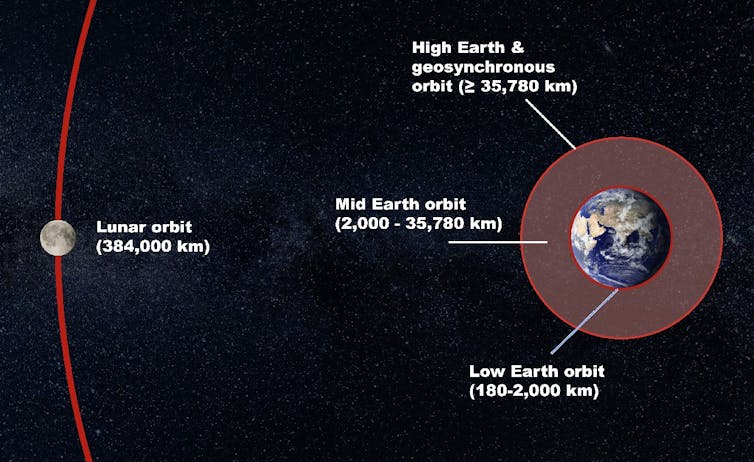
Satellites tend to be in three main orbits, and understanding these is key to understanding the complex nature of space debris.

An image of Earth with circles around it to indicate the distance of standard satellite orbits
Types of orbits around Earth classified by altitude (not to scale). Pexels/The Conversation, CC BY-SA

The most common orbit for satellites is low Earth orbit, with at least 5,900 active satellites. Objects in low Earth orbit tend to reside up to 1,000km above Earth’s surface and are constantly on the move. The International Space Station is an example of a low Earth orbit object, travelling around Earth 16 times every day.

Higher up is the medium Earth orbit, where satellites sit between 10,000 and 20,000km above Earth. It’s not a particularly busy place, but is home to some of the most important satellites ever launched – they provide us with the global positioning system or GPS.

Finally, we have very high altitude satellites in geosynchronous orbit. In this orbit, satellites are upwards of 35,000km above Earth, in orbits that match the rate of Earth’s rotation. One special type of this orbit is a geostationary Earth orbit. It lies on the same plane as Earth’s equator, making the satellites appear stationary from the ground.

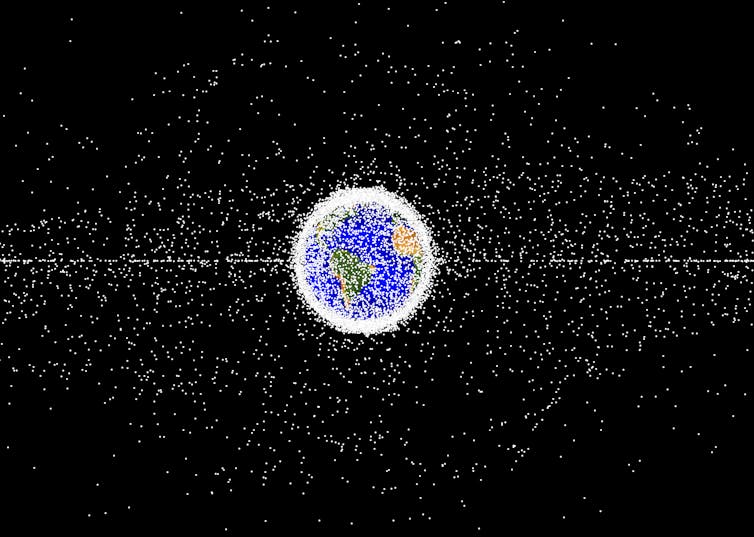
Visualisation of The European Space Agency’s Space Debris Office statistics on space debris orbiting Earth (as of January 8 2021).

As you can tell, Earth’s surrounds are buzzing with satellite activity. It only gets more chaotic when we factor in space junk, defined as disused artificial debris in orbit around Earth.

Space junk can range from entire satellites that are no longer in use or working, down to millimetre-wide bits of spacecraft and launch vehicles left in orbit. Latest estimates suggest there are more than 130 million pieces of space debris, with only 35,000 of those large enough (greater than 10cm) to be routinely tracked from the ground.

How do we track them all?

This is where space domain awareness comes in. It is the field of detecting, tracking and monitoring objects in Earth’s orbit, including active satellites and space debris.

We do much of this with ground-based tracking, either through radar or optical systems like telescopes. While radar can easily track objects in low Earth orbit, higher up we need optical sensors. Objects in medium Earth orbit and geostationary orbit can be tracked using sunlight reflected towards Earth.

For reliable and continuous space domain awareness, we need multiple sensors contributing to this around the globe.

Below you can see what high-altitude satellites can look like to telescopes on Earth, appearing to stay still as the stars move by.

Tracking two Optus satellites 16km apart, using EOS’ 0.7m deep space telescope at Learmonth, Western Australia. Source: EOS - Electro Optic Systems.

Australia’s role in space awareness

Thanks to our position on Earth, Australia has a unique opportunity to contribute to space domain awareness. The US already houses several facilities on the west coast of Australia as part of the Space Surveillance Network. That’s because on the west coast, telescopes can work in dark night skies with minimal light pollution from large cities.

Furthermore, we are currently working on a space domain awareness technology demonstrator (a proof of concept), funded by SmartSat CRC. This is a government-funded consortium of universities and other research organisations, along with industry partners such as the IT firm CGI.

We are combining our expertise in observational astrophysics, advanced data visualisation, artificial intelligence and space weather. Our goal is to have technology that understands what is happening in space minute-by-minute. Then, we can line up follow-up observations and monitor the objects in orbit. Our team is currently working on geosynchronous orbit objects, which includes active and inactive satellites.

EchoStar-7 was just one example of the fate of a retired spacecraft – the FCC is sending a strong warning to all other companies to ensure their debris mitigation plans are met.

Inactive objects in orbit could pose a collision risk to each other, leading to a rapid increase in space debris. If we want to use Earth’s space domain for as long as possible, we need to keep it safe for all.

Acknowledgment: The authors would like to thank Sholto Forbes-Spyratos, military space lead at CGI Space, Defence and Intelligence Australia, for his contribution to this article.The Conversation

Sara Webb, Postdoctoral Research Fellow, Centre for Astrophysics and Supercomputing, Swinburne University of Technology; Brett Carter, Associate Professor, RMIT University, and Christopher Fluke, SmartSat Professorial Chair, Swinburne University of Technology

This article is republished from The Conversation under a Creative Commons license. Read the original article.