Australian documentary film director, Christopher Nelius has created an entertaining, uplifting and quirky film with 'Whistle'. The documentary follows the preparation and staging of the world's greatest whistling competition held in Hollywood, Los Angeles, USA and includes interviews with key competitors in their own home countries in the UK, US, Spain and Japan. Whistling diva and producer of the competition, Carole Anne Kaufman is on a mission to elevate both whistling as an artform and the standing of this competition and the film captures her efforts from start to finish. It's an eccentric cast of characters altogether.
This is a professionally produced documentary with excellent editing, pacing and dramatic effects as the competition proceeds, without being overly sentimental. The film leaves the viewer with admiration for musical expertise and dedication of the competitors and the devoted commitment of the event organiser and her volunteers.
For documentary film lovers, this film is a must-see.
Researchers at the University of Cambridge have developed what they describe as a fundamentally new type of vaccine using artificial intelligence (AI). The vaccine’s key component was designed entirely by AI and has now been tested in people for the first time.
The goal is ambitious: a single vaccine that works not just against all known human coronavirus variants, but against related bat viruses that could jump from animals to humans and cause future pandemics.
Traditional vaccines train our immune system to recognise one specific virus. The problem is that viruses mutate. When they change enough, the vaccine stops working, which is why we need a new flu shot every year and why COVID vaccines have been updated repeatedly since 2021.
AI offers a way around this. By analysing genetic data from thousands of related viruses, it can identify the parts that stay the same across different strains and that are unlikely to change over time. Target those stable features, and you have a vaccine that should work against the whole family, not just the strain you started with.
This is exactly what the Cambridge team did. They used AI to scan viruses from the sarbecovirus family, which includes the viruses that cause both SARS and COVID, as well as a range of animal coronaviruses – looking for shared features that evolution has left largely untouched. Those features became the basis of the vaccine.
DNA vaccines
While many people are familiar with the mRNA shots used during the pandemic, this new vaccine uses DNA. DNA vaccines are generally more stable than mRNA vaccines, making them easier to store and transport. A significant advantage in lower-income countries where “cold-chain” infrastructure is limited.
They can also be administered without needles. A high-pressure stream of liquid delivers the vaccine through the skin, making administration less painful and easier to scale up during an outbreak.
DNA and RNA viruses explained.
Could it protect against future pandemics?
These practical advantages matter most if the vaccine itself can do something no existing jab can: protect against viruses we haven’t encountered yet.
Broad-spectrum vaccines could change the way the world responds to emerging infectious diseases. By offering much wider protection than traditional vaccines, they could provide rapid immunity against new and emerging viral threats. This would equip public health officials with tools to stop future outbreaks in their tracks before they have a chance to turn into global pandemics.
They could also transform our approach to more familiar diseases. Influenza is a prime target because it exists in many different strains and evolves so rapidly. Scientists have to predict which strains will dominate each flu season, and they guess wrong, vaccine effectiveness can suffer. A universal flu vaccine that targets features shared across multiple strains could eventually end the annual race to keep up with the virus.
And the Ebola virus shows why this matters right now. The recent outbreak in the Democratic Republic of the Congo and Uganda is driven by the Bundibugyo strain, which bypasses existing vaccines. While researchers rush to create a new vaccine specifically for this strain, local communities remain at high risk. A broad-spectrum vaccine designed to cover an entire virus family could transform that picture.
What the trial found
This is the first human trial of an AI-designed vaccine. The results showed that this DNA vaccine was able to stimulate the immune system to produce antibodies that can recognise different types of sarbecoviruses. The technology was found to be safe and well tolerated.
This is an exciting advance because it demonstrates how AI has the potential to design variant-proof vaccines against future pandemic threats. The needle-free delivery system could also make the vaccine easier to administer and distribute worldwide.
However, there is more work to do. Although the results in this study are encouraging, the immune responses following vaccination were modest. It was also uncertain how long the protection lasts and whether further boosters will be required. Larger trials are also needed to determine whether the vaccine can prevent or reduce virus infections in the real world.
A universal vaccine remains a few years away. And any new vaccine must still pass larger trials to prove it is safe, effective and provides lasting protection. But this study shows the goal is getting closer – and AI may help us get there faster.
Part 8 of this series on AI explored the impact of the new technology on the retail sector. This posting will further consider AI's effect on specific retail functions.
Marketing and advertsiing in retail
AI has most impact with -
Performance marketing: Google and Meta's advertising platforms are increasingly self-optimising with informed automation. The previous large teams of digital marketing specialists who managed bid strategies, audience targetting and creative testing are shrinking. The platforms can carry out the operations that previously employees would carry out.
Personalised communications: AI can and does generate individualised email, push notifications and SMS content at scale replacing or reducing human campaign teams.
Market research and consumer insight: AI can synthesise customer data, social media listening, consumjer feedback and sales patterns into insight reports thus reducing analyst headcount.
Fashion retail specifically
Fashion sits at the intersection between the retails and creative indsutries making it doubly exposed -
Trend forecasting: traditionally carried out by high-cost specialist agencies and in-house teams, AI can now analyse social media, runway coverage and sales data to predict trends with considerable accuracy.
Design assistance: Ai tools can and do generate design concepts, colourway combinations and print patterns. This places junior design assistant roles under pressure in a very cost conscious industry.
Fit and sizing: AI fit technology reduces return rates thus threatening the customer service infrastructure built around managing returns.
Wholesale and buying: the buyer role which requires relationship-building with suppliers and market intuition is more protected from AI encroachment. The analytical support underneath these roles is much less so.
At this stage AI appplication in fashion is more of an augmenting role rather than displacement of jobs but increasingly this may change.
Aliens might exist. But there are three reasons why they’re not visiting us
Steven Spielberg’s new film, Disclosure Day, explores the idea of extraterrestrial life.
UniversalCarol Oliver, UNSW Sydney
The United States government’s recent release of hundreds of previously classified Unidentified Anomalous Phenomena (UAPs) cases spanning the 1940s to the present, along with the new Steven Spielberg movie, Disclosure Day, about extraterrestrial life, has fuelled the idea that aliens are visiting Earth.
In fact, polls in Australia, the US and elsewhere indicate around a third of the public believes aliens are here.
However, while what we know about the universe suggests aliens may exist, there are three compelling reasons why they probably aren’t visiting us.
Space is big – very big
To begin with, space is vast – beyond our imagination.
Proxima Centauri, the nearest star to our Sun, is about 40 trillion kilometres away, 268,000 times farther than the Sun is from Earth. That’s 4.3 light years as astronomers measure it. A light year is the distance light travels in one year at 300,000km per second.
We can only travel across space at a fraction of the speed of light with current technology. Even our fastest spacecraft, the Parker Solar Probe, travels at a top speed of roughly 191 kilometres per second – 0.064% the speed of light.
At that speed, it would take about 6,650 years to reach Proxima Centauri, and that’s just in our local stellar neighbourhood. So interstellar travel within human lifespans would require much higher velocities.
Let’s assume we did have the means to travel close to the speed of light. That introduces the first problem with travelling at that velocity. Albert Einstein demonstrated that time is relative; the rate of time flow is not the same everywhere in the universe. The faster a spaceship travels from Earth, the slower time will pass for its passengers. This is called time dilation.
For example, when NASA astronaut Scott Kelly arrived back on Earth from a year on the International Space Station, he was milliseconds younger than his identical twin because time moves more slowly for objects in motion, and the International Space Station travels at roughly 28,150 kilometres per hour.
This difference was negligible for the Kelly twins. But for any aliens cartwheeling through our skies, it would be significantly more because of the journey to Earth and back from a distant star system at a necessarily higher speed. They would go home to a planet much older than the one they left – perhaps by a century or more. They would be time exiles.
A photograph from the Apollo 17 mission in December 1972.NASA
Unimaginably high energy requirements
Then there’s the unimaginably high energy requirement for interstellar travel.
The mass of the spaceship increases with velocity, so an increasing amount of energy is required to accelerate it.
At the speed of light, the ship becomes infinitely massive, requiring an infinite amount of energy. This is clearly impossible.
Another significant issue is that space is a vacuum – but not completely. There are just enough particles to worry about. They can potentially cause fatal radiation for passengers and the instruments of a high velocity spacecraft, or destroy it. Sparsely spread hydrogen atoms turn into intense radiation at near light speed, and the heat that is generated would ablate and eventually destroy the hull.
Faster-than-light travel, according to physicist Miguel Alcubierre, is possible, but it comes with its own set of issues and a currently impossible energy requirement.
That raises the question of why spend all this energy to travel to Earth? Anything we have, an advanced civilisation (as they would have to be to get here) would be able to make on their planet.
A unique biosphere
Yet another issue is our biosphere, unique to Earth as far as scientists know.
Life and the planet co-evolved. Complex life would not exist on Earth if cyanobacteria, a type of single-celled microbe, had not pumped oxygen into our mostly nitrogen atmosphere 2.4 billion years ago.
It’s therefore not toxic for us, but oxygen is reactive and could be highly corrosive for aliens. And while they could wear protective suits like humans do when going to inhospitable environments, reports of visiting aliens do not include any descriptions of spacesuits.
So, are aliens out there?
If aliens are not here, are they out there?
It’s an interesting question, scientifically and philosophically. Scientists do not have enough information yet, but they are working on the question.
About 6,200 exoplanets have been found in more than 4,700 solar systems, though none are like Earth or our Solar System.
Most stars could have at least one planet, and there are more than 100 billion stars in our galaxy alone. The number of planets is therefore astronomical, and some may be habitable.
Closer to home, there are worlds with potential for microbial life either past or present – Mars, Europa (a moon of Jupiter), and Enceladus and Titan (moons of Saturn). If we discover life began twice in our Solar System, that will increase the odds of life elsewhere.
Since 1960, we’ve had the capability to look for intelligence elsewhere, piggybacking on normal radio astronomy. The biggest search for alien life projects are carried out by the SETI Institute in California and the Breakthrough Listen project based at Oxford University in the United Kingdom.
Nothing has been found across all the searches made. Finding intelligence in our time frame – about a hundred years – in the 13.8-billion-year history of the universe is challenging.
However, as a 1959 Nature paper noted, while it’s difficult to estimate the chance of success, if we don’t search, the chance drops to zero.
The Sydney Film Festival (SFF) is currently running until 14 June 2026 with up to 18 separate screen venues in operation. With a mix of all genres of film and including major releases from the international film festivals, this blog will provide a series of film reviews from the SFF over coming days.
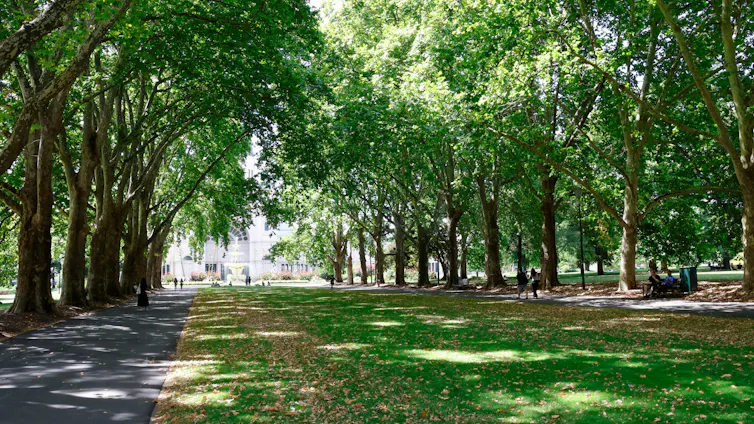
Cities around the world are planting more trees to cope with rising urban heat. But our research shows trees alone are often not enough. In some cases, the wrong kind of greening can even make streets feel less comfortable on a hot day.
We compared field measurements from Melbourne, Munich and Hong Kong to test how different kinds of urban planting changed the heat people experience outdoors.
The results showed layered vegetation – where trees are combined with shrubs and ground cover – often cooled cities more effectively than trees alone. We also found local climate and street design strongly shaped whether greening worked well.
These findings matter because urban greening is no longer just about aesthetics. As cities spend billions adapting to extreme heat, planting design may matter as much as planting quantity.
Cities are getting hotter
Cities trap heat. Roads, buildings and asphalt absorb solar energy during the day and slowly release it back into the air, especially at night.
This “urban heat island” effect, combined with climate change, is making heatwaves more intense and more dangerous in our cities.
Trees are one of the most popular responses because they provide shade and reduce the amount of heat absorbed by surrounding surfaces. But outdoor comfort depends on more than air temperature alone.
People experience heat through sunlight, reflected heat, humidity and airflow. A shaded street can still feel uncomfortable if humidity is high or if wind cannot move through the space.
That is why a “one-size fits all” greening strategy can fail. A planting design that works well in Melbourne may behave very differently in Hong Kong or Munich.
What we found
To better understand how urban vegetation affects heat stress, we did field measurements in three cities with different climates: temperate Melbourne, cooler Munich and humid subtropical Hong Kong.
Rather than relying only on computer models, we measured real conditions in streets and green spaces during summer.
We compared open urban spaces (with no plantings), sites with trees only, and layered planting (which means trees, shrubs and ground cover together).
Importantly, we did not just measure air temperature. We also measured “mean radiant temperature”, which captures the heat radiating from roads, walls and other surfaces onto the human body.
In Melbourne, street trees reduced radiant heat absorbed by pedestrians by more than 18°C, compared with open streets. Even where air temperatures changed only slightly, shaded streets felt substantially cooler.
Munich showed the strongest benefits from layered planting. There, streets and green spaces containing trees, shrubs and ground cover reduced afternoon heat stress by almost 8°C compared with more open spaces.
Hong Kong also benefited from vegetation, especially through shade created by overlapping tree canopies. But the results there were more mixed because the humid climate changed how cooling worked (more on that later).
Across all three cities, one finding stood out: vegetation structure matters.
Combining trees with shrubs and ground cover often performed better than trees alone, but the benefits depended on how the planting interacted with the local environment.
Why some greening can fail
The study showed that more vegetation is not automatically better.
In Hong Kong, dense vegetation sometimes increased humidity enough to reduce some of the cooling benefit. Plants release water vapour into the air through transpiration, which can help to cool dry climates. But in already humid cities, extra moisture can make outdoor spaces feel sticky and uncomfortable because sweat evaporates less efficiently.
In some Munich streets, dense vegetation reduced airflow through narrow urban corridors, trapping warm air and slowing the movement of vehicle pollution away from pedestrians.
These findings highlight why cities cannot rely on generic canopy targets copied from elsewhere. Climate, street width and airflow all shape whether vegetation improves comfort or creates unintended side effects.
Designing cooler cities
The solution is not to stop planting trees. It is to design urban greening more carefully.
Cities need planting strategies tailored to local conditions rather than universal greening formulas. In parks and open green spaces, layered vegetation can provide strong cooling while also supporting biodiversity. In dense streets, planners may need to balance shade with ventilation.
The findings also suggest cities should move beyond measuring success through tree numbers alone. The arrangement, density and type of vegetation matter just as much as canopy cover.
Designing for local conditions
Our research shows urban vegetation can reduce heat stress, but the benefits depend on how and where cities plant it.
Melbourne demonstrated the strong cooling effect of street trees on radiant heat, Munich showed the added value of layered vegetation, and Hong Kong revealed how dense planting can sometimes backfire in humid conditions.
Cities need climate-smart green spaces designed for local conditions, airflow and human comfort to remain liveable as temperatures rise.