Thursday, 4 December 2025

Health - safety of mosquito repellents


Are mozzie repellents safe to use? And do I really need them in Australia?

Cameron Webb, University of Sydney

Summer’s here and after a wet spring in many parts of Australia, mosquitoes are out in force. Insect repellent has become a routine requirement for time outdoors.

But how safe are they? And do we really need them?

What can go wrong after a mosquito bite?

A bite from a mosquito can be itchy and irritating. Even a mild reaction can have us scratching, especially if you’re one of the people who are irresistible to mosquitoes.

The swelling and itchiness usually resolves in a few days. But scratching can result in secondary infection, especially for young children, if dirt and germs from underneath the fingernails get into the sore.

A mosquito bite can also cause disease. Not all diseases are life-threatening but they can be severely debilitating.

These diseases are a risk in most parts of Australia. Even cooler regions such as Victoria and Tasmania have mosquito-borne diseases which can be seriously debilitating.

Stop the bite, stop getting sick

There are no specific cures for our local mosquito-borne diseases. While there is a vaccine available for Japanese encephalitis, preventing bites in the first place is the best way to prevent illnesses caused by Ross River, Murray Valley encephalitis and a range of other pathogens spread by mosquito bites.

Australian health authorities regularly review the recommendations for insect repellent use. But the range of formulations filling our supermarket shelves can change from summer to summer.

The Australian Pesticides and Veterinary Medicines Authority (APVMA) assesses insect repellents for their safety and effectiveness. Packaging should clearly display an APVMA registration number, along with directions for safe use and any required warnings, on their label.

Three colourful containers of mosquito repellent
Products sold as mosquito repellents in Australia must be registered with the Australian Pesticides and Veterinary Medicines Authority. Cameron Webb (NSW Health Pathology & University of Sydney), CC BY

What’s in popular mozzie repellents?

The most widely available active ingredients are diethyltoluamide (DEET), picaridin and oil of lemon eucalyptus (OLE).

Plant-derived products, including eucalyptus and tea tree oil, are also popular alternatives. These strongly smelling products are registered by the APVMA and provide some protection but need to be reapplied more frequently than other repellents.

Are mosquito repellents safe?

Insect repellents are often thought to be unpleasant to use, or even a health risk themselves, but the inconvenience of using a repellent is easily outweighed by the benefit of reducing mosquito bites.

Research and reviews from scientists and health authorities show mosquito repellents are a safe and effective way to prevent mosquito bites if used as recommended.

Scientists investigate each active ingredient to determine whether it’s safe. DEET has been the subject of many studies. Picaridin and oil of lemon eucalyptus haven’t been used for as long and haven’t been as thoroughly studied as DEET, but remain among those recommended by health authorities in Australia and overseas.

Natural repellents, especially unregistered and DIY formulations, may may cause skin reactions or come with other risks, so stick with products that have been registered after being tested for safety or effectiveness.

However, even if a product has been deemed safe, it is important to follow the directions for use on label. There will always be a risk if products are ingested in large quantities or intentionally misused.

What about babies and young children?

Most mosquito repellent formulations in Australia are registered for use on children over 12 months of age, although not all formulations list a specific age restriction.

International studies have shown that DEET and picaridin are safe for children. Recommended age limits for some mosquito repellents vary between countries and product type. In the United States, for example, there is no age limit for the use of DEET, while oil of eucalyptus is recommended only for children over three.

A 2024 study reviewing reports of adverse outcomes from mosquito repellent use concluded DEET was the preferred insect repellent for children, as it was the safest and offered long-lasting protection against biting mosquitoes when used as directed. The researchers noted other active ingredients may provide similar protections but more assessments were required to determine their safety.

A black mosquito biting a person's hand
Mosquito bites can be annoying but also lead to illness. A/Prof Cameron Webb (NSW Health Pathology & University of Sydney)

Tips for parents of babies and young children

Always be guided by the current recommendations of the APVMA and limit the use of DEET-based repellent from 12 months. Check the label before using mosquito repellent on children.

When you’re applying repellent, ideally apply it to your hands, then rub it on their skin. If you’re using a spray, apply it carefully and never directly onto a child’s face.

Don’t allow children to apply their own repellent, as it may lead to accidental ingestion or over-exposure.

When babies and toddlers are outdoors, consider using an insect net for strollers, prams or playpens.

While wrist bands, patches and stickers are marketed as mosquito repellents for children, there is little evidence they are effective. Smouldering devices, such as coils and sticks, aren’t a good idea when there is a chance of breathing in the smoke.

How do different varieties compare?

Unlike sunscreens, which have a SPF rating, there isn’t a single measure with which to compare the different formulations of mosquito repellents and their effectiveness.

“Heavy duty” or “tropical strength” formulations often contain the same active ingredients as those known as “kid friendly”, but in higher doses that last longer. Lower concentrations still offer good mosquito bite protection, they just need to reapplied more often.

The secret to getting the best protection is to ensure mosquito repellents are applied correctly. Whether you use a cream, lotion, gel, roll-on, pump-spray or aerosol, make sure all exposed skin is covered. Reapply after swimming, sweaty exercise, or if it has rubbed off.The Conversation

Cameron Webb, Clinical Associate Professor, School of Medical Science & Sydney Infectious Diseases Institute; Principal Hospital Scientist, University of Sydney

This article is republished from The Conversation under a Creative Commons license. Read the original article.

Tuesday, 2 December 2025

Health - recommended steps by age group

In various lifestyle magazines and health journals, the benefits of daily walking have often been cited with varying distances and number of steps mentioned. Good evidence and factual information is missing from many of the published articles leaving the reader wondering, how much should I do ? Research does exist and a summary of findings reveals there are some recommended step counts by age group -

Children and teens: 10,000 - 14,000 steps per day for growth and fitness (this would include playing sports so the number of steps would be easily achieved),

Adults under 60 years of age: 8,000 - 10,000 steps per day for optimal cardiovascular and metabolic health,

Adults over 60 years of age: 6,000 - 8,000 steps per day to reduce chronic disease and maintain mobility. The estimation of 3,000 steps per day to reduce the risk of Alzeheimers from the Harvard University study is also valid in this context.

Overall large scale studies have shown that 7,000 steps per day is an optimum level linked to significant reductions in mortality risk. This matches with epidemiologists' recommendations, highlighting a range of 6,000 - 8,000 steps as a method for reducing dementia risk with significant protection against memory and cognitive functional decline.

Climate change - the past as a guide to the future - plants cannot quickly adapt to warmer temperatures


56 million years ago, the Earth suddenly heated up – and many plants stopped working properly

Vera Korasidis, The University of Melbourne and Julian Rogger, University of Bristol

Around 56 million years ago, Earth suddenly got much hotter. Over about 5,000 years, the amount of carbon in the atmosphere drastically increased and global temperatures shot up by some 6°C.

As we show in new research published in Nature Communications, one consequence was that many of the world’s plants could no longer thrive. As a result, they soaked up less carbon from the atmosphere, which may have contributed to another interesting thing about this prehistoric planetary heatwave: it lasted more than 100,000 years.

Today Earth is warming around ten times faster than it did 56 million years ago, which may make it even harder for modern plants to adapt.

Rewinding 56 million years

Plants can help regulate the climate through a process known as carbon sequestration. This involves capturing carbon dioxide from the atmosphere via photosynthesis and storing it in their leaves, wood and roots.

However, abrupt global warming may temporarily impact this regulating function.

Investigating how Earth’s vegetation responded to the rapid global warming event around 56 million years ago – known formally as the Paleocene-Eocene Thermal Maximum (or PETM) – isn’t easy.

To do so, we developed a computer model simulating plant evolution, dispersal, and carbon cycling. We compared model outputs to fossil pollen and plant trait data from three sites to reconstruct vegetation changes such as height, leaf mass, and deciduousness across the warming event.

The three sites include: the Bighorn Basin in the United States, the North Sea and the Arctic Circle.

We focused our research on fossil pollen due to many unique properties.

First, pollen is produced in copious amounts. Second, it travels extensively via air and water currents. Third, it possesses a resilient structure that withstands decay, allowing for its excellent preservation in ancient geological formations.

A shift in vegetation

In the mid-latitude sites, including the Bighorn Basin – a deep and wide valley amidst the northern Rocky Mountains – evidence indicates vegetation had a reduced ability to regulate the climate.

Pollen data shows a shift to smaller plants such as palms and ferns. Leaf mass per area (a measure of leaf density and thickness) also increased as deciduous trees declined. Fossil soils indicate reduced soil organic carbon levels.

The data suggest smaller, drought-resistant plants including palms thrived in the landscape because they could keep pace with warming. They were, however, associated with a reduced capacity to store carbon in biomass and soils.

In contrast, the high-latitude Arctic site showed increased vegetation height and biomass following warming. The pollen data show replacement of conifer forests by broad-leaved swamp taxa and the persistence of some subtropical plants such as palms.

The model and data indicate high-latitude regions could adapt and even increase productivity (that is, capture and store carbon dioxide) under the warmer climate.

A glimpse into the future

The vegetation disruption during the PETM may have reduced terrestrial carbon sequestration for 70,000-100,000 years due to the reduced ability of vegetation and soils to capture and store carbon.

Our research suggests vegetation that is more able to regulate the climate took a long time to regrow, and this contributed to the length of the warming event.

Global warming of more than 4°C exceeded mid-latitude vegetation’s ability to adapt during the PETM. Human-made warming is occurring ten times faster, further limiting the time for adaptation.

What happened on Earth 56 million years ago highlights the need to understand biological systems’ capacity to keep pace with rapid climate changes and maintain efficient carbon sequestration.The Conversation

Vera Korasidis, Lecturer in Environmental Geoscience, The University of Melbourne and Julian Rogger, Senior Research Associate, School of Geographical Sciences, University of Bristol

This article is republished from The Conversation under a Creative Commons license. Read the original article.

Sunday, 30 November 2025

Health - Exercise and walking to avoid Alzeheimers disease

                                               GPT-5 AI generated
How many daily steps does it take to reduce the risk of serious disease and promote good health ? Apparently for some age groups, its less than originally thought. The oft-quoted 10,000 daily steps has long been unmasked as being based on no evidence or science at all but rather a Japanese marketing campaign. Recent studies with actual research and using live subjects concluded around 9,000 steps per day was optimum for good health.

A study from Harvard University has since found that older people and particularly those at risk of developing Alzheimer's disease require only 3,000 steps per day. The study team led by Wai-Ying Yau analysed physical activity data from 296 cognitively healthy people aged between 50 and 90 years of age. Using a step-tracking device and brain imaging to obtain a baseline measurement of misfolded proteins (tau and beta-amyloid) that are suspected of causing Alzheimers, the subjects were measured every two to three years for a period of between 3 and 14 years. The researchers found that the levels of accumulation of misfolded tau was substantially slowed by taking between 3,000 and 5,000 steps per day. The exercise had no effect on beta-amyloid however this protein is less implicated in causing Alzheimers than tau. Between 5,000 and  7,500 steps per day was even more effective with a reduction in cognitive decline of 54 per cent compared to being inactive. 

Why is this exercise so effective ? The hypothesis is that exercise reduces inflammation which is associated as a key factor in Alzheimers. Blood flow is also boosted to the brain and levels of protective hormones are increased. 

Friday, 28 November 2025

Climate Change - COP30 ended with some results


This year’s climate talks saw real progress – just not on fossil fuels

Antonio Scorza/COP30, CC BY-NC-ND


Jacqueline Peel, The University of Melbourne

It wasn’t a comfortable process for the tens of thousands of delegates trying to hash out progress on climate change on the edge of the Amazon in Belém, Brazil. I experienced the challenges of the United Nations COP30 climate talks firsthand.

Delegates were hot and sweaty. Tech and aircon didn’t always work. Both flood and fire disrupted negotiations over the fortnight of negotiations. It drove home how climate change feels. But despite the discomfort, some progress was made.

Brazilian President Luiz Inácio Lula da Silva dubbed it the “COP of Truth”. Delegates did not shy away from the urgency of the moment as climate change intensifies and emissions continue to climb.

Ahead of the talks, many feared global political headwinds and the United States’ departure from the Paris Agreement would undermine this year’s talks. The fact that nearly 60,000 delegates attended these talks – the second highest ever – shows this isn’t the case.

Progress was made on funding climate finance and adaptation to the changes already emerging. But efforts on ending reliance on fossil fuels faltered in the face of strong resistance by fossil fuel powers. Much progress in Belém happened outside the main talks.

So what did COP30 deliver?

At one stage it looked like COP30 might crack the hardest nut in climate policy – reaching agreement on phasing out fossil fuels. Nations agreed two years ago that it was necessary to move away from fossil fuels. But no plan had yet been devised to get there.

Brazil had a plan: build support for a roadmap to phase out fossil fuels, championed by President Lula and pushed strongly by Environment Minister Marina Silva. It drew support from more than 80 countries, including major fossil fuel exporters such as Norway and Australia. Anticipating pushback, Brazil worked to boost support outside the main talks before bringing the plan in.

It didn’t work. By the end of COP30, all mention of a fossil fuel roadmap had been scrubbed from the text of the final outcomes, following fierce pushback from countries such as Russia, Saudi Arabia and India and many emerging economies.

Instead, countries agreed to launch “the Global Implementation Accelerator […] to keep 1.5°C within reach” and “taking into account” previous COP decisions. This initiative will be shepherded by the Brazilian COP30 Presidency and the leaders of next year’s COP31 talks, Turkey and Australia.

President Lula vowed to continue advocating for a fossil fuel roadmap at the G20. Colombia and the Netherlands will hold a conference on fossil fuel phaseout in April 2026. The COP30 decision text also makes reference to a “high-level event in 2026” which could take place in the Pacific. Without blockers of consensus at these meetings, a coalition of willing countries could make real progress in setting timelines and exchanging policy ideas for fossil fuel phase-out.

woman standing at podium.
Brazil’s Environment Minister Marina Silva emerged as a quiet force working to build support for the first roadmap to phase out fossil fuel extraction and use. Aline Massuca/COP30, CC BY-NC-ND

The decision to develop a just transition mechanism was welcomed as a win for workers and communities. The new mechanism’s purpose will be to increase international cooperation, technical assistance, capacity-building and knowledge-sharing as countries shift towards a low carbon global economy.

Efforts to boost financing for climate adaptation bogged down, reflecting the trade-offs over fossil fuels.

These funds are meant to help nations most exposed to severe climate damage, usually poorer and with low emissions. These nations led the charge for a tripling of climate finance by 2030 from the US$40 billion (A$62 billion) agreed at COP26 four years ago. But the agreed text merely “calls for efforts to at least triple adaptation finance by 2035”, which pushes out the timeframe and has no funding baseline.

Funding for tropical forests

One of Brazil’s own initiatives, the Tropical Forest Facility, achieved greater success, securing US$9.5 billion (A$14.7 billion) in funding pledges – a COP record.

The trust fund for rainforests is designed to provide resources to arrest global deforestation and protect Indigenous lands, including in the Amazon’s vital carbon sink.

Support for a roadmap towards ending deforestation secured 92 backers.

The success of these deforestation initiatives points to the effectiveness of the COP’s Action Agenda, aimed at spurring on climate action outside formal negotiations and including commitments from business, investors and civil society. As formal negotiations bog down, these bypasses may end up replacing negotiations in driving progress.

American absence

Ahead of COP30, analysts feared the ongoing attacks on climate action by the Trump administration would undermine the international negotiations.

COP30 was the first climate summit without a US government delegation. At first, the absence came as a relief.

But by summit’s end, the disappearance of the world’s biggest historical emitter and largest economy from negotiations had taken its toll.

Developing countries from the African group of negotiators argued better metrics and plans would be meaningless without funding to implement them. Traditionally, the US has been a major funder. No longer.

The US decision to turn its back on climate action created a subdued atmosphere. New finance pledges were broadly underwhelming, likely due to the dampening effect of the US retreat.

people taking photos of a pavilion at global talks.
China’s negotiators focused most of their energy in pushing back on European trade measures targeting high-emissions products. Antonio Scorza/COP30, CC BY-NC-ND

Early on, many hoped renewables and clean tech giant China might fill the leadership void. China’s clean tech exports last year were enough to cut overseas emissions by 1%. The huge industrial power produces almost 32% of the world’s carbon emissions. These emissions have plateaued, in turn suggesting global emissions may now have peaked.

But China showed reluctance to take up the mantle, preferring to remain focused on its own domestic energy transition. Chinese negotiators spent most of their energy pushing back against new European trade measures targeting emissions-intensive production.

It was left to some of the smallest nations, Indigenous peoples and civil society to lead calls for sticking to the science, ramping up urgency and accelerating the rollout of solutions. An estimated 70,000 people marched in the streets of Belém, staging a mock funeral for fossil fuels. It was an important affirmation of widespread public support for climate action.

What legacy?

As the UN’s climate Executive Secretary Simon Stiell said midway through COP30, nations had to “give a little to get a lot”.

Many countries will be reflecting they gave a lot but got very little. The biggest winners were, yet again, the world’s petrostates who successfully frustrated attempts to address fossil fuels.

Questions will inevitably be asked over whether these consensus-based talks are fit for purpose, given they can be gamed by blockers.

For many, COP30 will be regarded as a failure on fossil fuels and addressing major gaps between national pledges to cut emissions and what’s needed to hold warming to 1.5°C.

This is true. But another view would be that these talks made real progress on important areas despite considerable challenges.

Negotiators from 194 countries showed up and continued to talk and work together to tackle the worsening crisis. Nearly half of those countries have shown they’re ready to begin weaning themselves off fossil fuels through their support for the phase-out roadmap. They don’t have to wait for a UN consensus to act. Fossil fuel exporters only have power while other nations buy and rely on their products.

The world’s climate talks are now clearly moving away from arcane negotiations to the pressing real-world challenges of doing the work. In a rapidly warming world, all issues are becoming climate issues.The Conversation

Jacqueline Peel, Professor of Law, The University of Melbourne

This article is republished from The Conversation under a Creative Commons license. Read the original article.

Saturday, 15 November 2025

Environment - Climate Change - reduced carbon emissions in 35 countries


The world’s carbon emissions continue to rise. But 35 countries show progress in cutting carbon

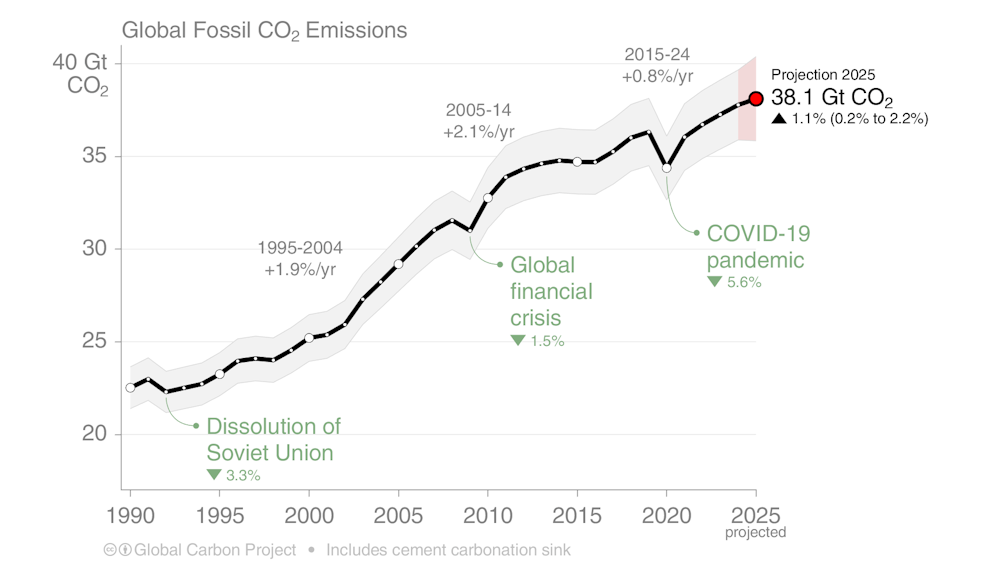
Global fossil fuel emissions are projected to rise in 2025 to a new all-time high, with all sources – coal, gas, and oil – contributing to the increase.

At the same time, our new global snapshot of carbon dioxide emissions and carbon sinks shows at least 35 countries have a plan to decarbonise. Australia, Germany, New Zealand and many others have shown statistically significant declines in fossil carbon emissions during the past decade, while their economies have continued to grow. China’s emissions have also been been growing at a much slower pace than recent trends and might even be flat by year’s end.

As world leaders and delegates meet in Brazil for the United Nations’ global climate summit, COP30, many countries that have submitted new emissions commitments to 2035 have shown increased ambition.

But unless these efforts are scaled up substantially, current global temperature trends are projected to significantly exceed the Paris Agreement target that aims to keep warming well below 2°C.

figure showing 35 countries whose emissions are reducing


These 35 countries are now emitting less carbon dioxide even as their economies grow. Global Carbon Project 2025, CC BY-NC-ND

Fossil fuel emissions up again in 2025

Together with colleagues from 102 research institutions worldwide, the Global Carbon Project today releases the Global Carbon Budget 2025. This is an annual stocktake of the sources and sinks of carbon dioxide worldwide.

We also publish the major scientific advances enabling us to pinpoint the global human and natural sources and sinks of carbon dioxide with higher confidence. Carbon sinks are natural or artificial systems such as forests which absorb more carbon dioxide from the atmosphere than they release.

Global CO₂ emissions from the use of fossil fuels continue to increase. They are set to rise by 1.1% in 2025, on top of a similar rise in 2024. All fossil fuels are contributing to the rise. Emissions from natural gas grew 1.3%, followed by oil (up 1.0%) and coal (up 0.8%). Altogether, fossil fuels produced 38.1 billion tonnes of CO₂ in 2025.

Not all the news is bad. Our research finds emissions from the top emitter, China (32% of global CO₂ emissions) will increase significantly more slowly below its growth over the past decade, with a modest 0.4% increase. Emissions from India (8% of global) are projected to increase by 1.4%, also below recent trends.

However, emissions from the United States (13% of global) and the European Union (6% of global) are expected to grow above recent trends. For the US, a projected growth of 1.9% is driven by a colder start to the year, increased liquefied natural gas (LNG) exports, increased coal use, and higher demand for electricity.

EU emissions are expected to grow 0.4%, linked to lower hydropower and wind output due to weather. This led to increased electricity generation from LNG. Uncertainties in currently available data also include the possibility of no growth or a small decline.

figure showing global carbon emissions 2025.


Fossil fuel emissions hit a new high in 2025, but the growth rate is slowing and there are encouraging signs from countries cutting emissions. Global Carbon Project 2025, CC BY-NC-ND

Drop in land use emissions

In positive news, net carbon emissions from changes to land use such as deforestation, degradation and reforestation have declined over the past decade. They are expected to produce 4.1 billion tonnes of carbon dioxide in 2025 down from the annual average of 5 billion tonnes over the past decade. Permanent deforestation remains the largest source of emissions. This figure also takes into account the 2.2 billion tonnes of carbon soaked up by human-driven reforestation annually.

Three countries – Brazil, Indonesia and the Democratic Republic of the Congo – contribute 57% of global net land-use change CO₂ emissions.

When we combine the net emissions from land-use change and fossil fuels, we find total global human-caused emissions will reach 42.2 billion tonnes of carbon dioxide in 2025. This total has grown 0.3% annually over the past decade, compared with 1.9% in the previous one (2005–14).

Carbon sinks largely stagnant

Natural carbon sinks in the ocean and terrestrial ecosystems remove about half of all human-caused carbon emissions. But our new data suggests these sinks are not growing as we would expect.

The ocean carbon sink has been relatively stagnant since 2016, largely because of climate variability and impacts from ocean heatwaves.

The land CO₂ sink has been relatively stagnant since 2000, with a significant decline in 2024 due to warmer El Niño conditions on top of record global warming. Preliminary estimates for 2025 show a recovery of this sink to pre-El Niño levels.

Since 1960, the negative effects of climate change on the natural carbon sinks, particularly on the land sink, have suppressed a fraction of the full sink potential. This has left more CO₂ in the atmosphere, with an increase in the CO₂ concentration by an additional 8 parts per million. This year, atmospheric CO₂ levels are expected to reach just above 425 ppm.

Tracking global progress

Despite the continued global rise of carbon emissions, there are clear signs of progress towards lower-carbon energy and land use in our data.

There are now 35 countries that have reduced their fossil carbon emissions over the past decade, while still growing their economy. Many more, including China, are shifting to cleaner energy production. This has led to a significant slowdown of emissions growth.

Existing policies supporting national emissions cuts under the Paris Agreement are projected to lead to global warming of 2.8°C above preindustrial levels by the end of this century.

This is an improvement over the previous assessment of 3.1°C, although methodological changes also contributed to the lower warming projection. New emissions cut commitments to 2035, for those countries that have submitted them, show increased mitigation ambition.

This level of expected mitigation falls still far short of what is needed to meet the Paris Agreement goal of keeping warming well below 2°C.

At current levels of emissions, we calculate that the remaining global carbon budget – the carbon dioxide still able to be emitted before reaching specific global temperatures (averaged over multiple years) – will be used up in four years for 1.5°C (170 gigatonnes remaining), 12 years for 1.7°C (525 Gt) and 25 years for 2°C (1,055 Gt).

Falling short

Our improved and updated global carbon budget shows the relentless global increase of fossil fuel CO₂ emissions. But it also shows detectable and measurable progress towards decarbonisation in many countries.

The recovery of the natural CO₂ sinks is a positive finding. But large year-to-year variability shows the high sensitivity of these sinks to heat and drought.

Overall, this year’s carbon report card shows we have fallen short, again, of reaching a global peak in fossil fuel use. We are yet to begin the rapid decline in carbon emissions needed to stabilise the climate.The Conversation

Pep Canadell, Chief Research Scientist, CSIRO Environment; Executive Director, Global Carbon Project, CSIRO; Clemens Schwingshackl, Senior Researcher in Climate Science, Ludwig Maximilian University of Munich; Corinne Le Quéré, Royal Society Research Professor of Climate Change Science, University of East Anglia; Glen Peters, Senior Researcher, Center for International Climate and Environment Research - Oslo; Judith Hauck, Helmholtz Young Investigator group leader and deputy head, Marine Biogeosciences section at the Alfred Wegener Institute, Universität Bremen; Julia Pongratz, Professor of Physical Geography and Land Use Systems, Department of Geography, Ludwig Maximilian University of Munich; Mike O'Sullivan, Lecturer in Mathematics and Statistics, University of Exeter; Pierre Friedlingstein, Chair, Mathematical Modelling of Climate, University of Exeter, and Robbie Andrew, Senior Researcher, Center for International Climate and Environment Research - Oslo

This article is republished from The Conversation under a Creative Commons license. Read the original article.