Wednesday, 28 January 2026

Health - Fish oil and Omega 3 benefits and limitations


Should I take a fish oil supplement for my heart, joints or mood?

Mary Bushell, University of Canberra

Fish oil, also known as omega-3, is one of the most popular dietary supplements. It’s often promoted to protect the heart, boost mood, reduce inflammation and support overall health.

But how much of this is backed by science, and when might fish oil supplements actually be worth taking?

A long history

People have been taking oils from fish for centuries.

Modern interest surged in the 1970s when scientists studying Inuit diets discovered omega-3 fatty acids and their heart-protective effects.

By the 1980s, fish oil capsules were being marketed as an easy way to get these healthy fats.

What’s in fish oil?

Fish oil comes from oily fish such as salmon, sardines, tuna, herring and mackerel. It’s rich in a special type of fat called omega-3 polyunsaturated fatty acids (PUFAs), mainly EPA (eicosapentaenoic acid) and DHA (docosahexaenoic acid).

These omega-3s play an important role in how our cells function. Every cell in the body is surrounded by a thin, flexible layer called a cell membrane. This membrane works like a protective skin: it keeps the cell’s contents safe, controls what moves in and out, and helps cells communicate with one another.

Omega-3s don’t build the membrane itself, but they slot into it, becoming part of its structure. This helps the membrane stay fluid and flexible, allowing it to work more efficiently, especially in tissue that relies on fast, precise signalling, such as in the brain and eyes.

Because we can’t make enough omega-3s on our own, we need to get them from food or, sometimes, supplements.

How are fish oil supplements made?

After fish are caught, their tissues are cooked and pressed to release oil. This crude oil is purified and refined to remove impurities including heavy metals such as copper, iron and mercury.

During processing, the oil may be concentrated to boost its EPA and DHA content.

The purified oil is then encapsulated in soft gels or bottled as liquid oil.

Some supplements are further treated to reduce odour or the familiar “fishy” aftertaste.

Fish oil and heart health

Omega-3 fatty acids are best known for their role in heart health, particularly for lowering triglycerides, a type of fat in the blood that, when elevated, can increase the risk of heart disease.

A 2023 paper pooled 90 clinical trials with more than 72,000 participants and found a near linear relationship between dose and effect. That doesn’t mean “more is always better”, but higher doses tended to produce bigger improvements in heart-related risk factors.

It found you need more than 2 grams per day of EPA and DHA combined to meaningfully lower triglycerides (by 15 to 30%). This is most relevant for people with existing heart disease, high triglycerides, or obesity.

But it’s important to read the label. A “1,000 mg” fish oil capsule usually refers to the total oil weight of the oil, not the active omega-3 content. Most standard capsules contain only about 300 mg of combined EPA and DHA the rest is other fats.

At lower doses, changes in blood fats were modest. The same analysis suggested low-dose fish oil may even nudge LDL or “bad” cholesterol up slightly, while having only a small effect on triglycerides.

Fish oil capsules
At lower doses, any changes to heart health are modest. Pixabay/Pixels

A 2018 trial tested a high-strength purified EPA product (4 grams per day) in people already taking statins to lower their cholesterol. Over five years, it prevented one major heart event (heart attack, stroke or urgent procedure) for every 21 people treated. However this was a prescription-only pharmaceutical-grade EPA, not a standard fish-oil capsule.

In Australia, fish oils are sold in pharmacies, health food stores and supermarkets. Some concentrated products are available as “practitioner-only” supplements via health professionals.

The same purified EPA used in the 2018 trial is now available in Australia as Vazkepa, a prescription-only medicine. It was added to the Pharmaceutical Benefits Scheme (PBS) in October 2024, making it more accessible for high-risk patients.

For otherwise healthy people, the evidence that standard fish oil supplements prevent heart attacks or strokes is much less convincing.

What about arthritis and joint pain?

Fish oil has mild anti-inflammatory effects.

In people with inflammatory arthritis (such as rheumatoid arthritis), omega-3s can reduce joint tenderness and morning stiffness.

These benefits, however, require higher consistent doses, usually around 2.7g of EPA and DHA per day. This is the equivalent of around nine standard 1,000mg fish oil capsules (containing 300 mg of EPA and DHA) daily for at least eight to 12 weeks.

Can fish oil improve mood?

Some studies suggest omega-3s, particularly those higher in EPA, can modestly reduce symptoms of clinical depression when taken alongside antidepressants.

A 2019 review of 26 trials (involving more than 2,000 people) found a small overall benefit, mainly for EPA-rich formulations at doses up to about 1 gram per day. DHA-only products didn’t show clear effects.

That doesn’t mean fish oil is a mood booster for everyone. For people without diagnosed depression, omega-3 supplements haven’t been shown to reliably lift mood or prevent depression.

How much can you take?

For most people, fish oil is safe.

Common side effects include a fishy aftertaste, mild nausea and diarrhoea. Taking capsules with food or choosing odourless or “de-fishified” products can help.

Prescription strength products such as Vazkepa (high-dose EPA) are also well tolerated, but they can slightly increase the risk of irregular heartbeat (atrial fibrillation) and bleeding.

Up to 3 grams per day of combined EPA and DHA from supplements is generally considered safe for most adults.

Higher doses for specific medical conditions should be taken under medical supervision.

So, should you take it?

The Heart Foundation recommends Australians eat two to three serves of oily fish a week. This would provide 250–500 mg of EPA and DHA per day.

If you don’t eat fish, a fish oil supplement (or algal oil if you’re vegetarian or vegan) can help you meet your omega-3 needs.

If you have heart disease (with high triglycerides) or inflammatory arthritis, fish oil may offer extra benefits. But dose and product type matter, so speak with a health professional.

For most people, though, two or three serves of oily fish each week remain the simplest, safest and most nutritious way to get omega-3s.The Conversation

Mary Bushell, Clinical Associate Professor in Pharmacy, University of Canberra

This article is republished from The Conversation under a Creative Commons license. Read the original article.

Wednesday, 21 January 2026

Environment - shark attacks in Australia

Figure 1 Source: The Conversation (c) 2025 and NSW Government Sharksmart


Shark attacks against humans in the ocean are not regular incidents in Australia despite the number of people swimming/diving/surfing in the sea and the proximity of numerous species of shark. The recent 4 attacks in 48 hours in the coastline of NSW is unusual and has given rise to discussion as to the reasons why this activitry is occuring. Figure 1 (above) shows the most common species of shark responsible for attacks over the past thirty years. Some of the shark species are known for being ocean hunters (Great White, Tiger shark) while others are well known as species found in harbours, river estuaries and inlets (Bull shark). Figure 2 below provides the statistical data of shark incidents showing that the Great White shark is by far the greatest source of attacks.

The recent spate of attacks and a more broad trend of shark activity is conisdered by several marine scientists as being linked to land activities and the impact on the ocean. The washing offshore of runoff of pesticides, waste, organic nutrients and other waste together with murky water from storms creates a perfect hunting environment for predatory sharks as bait fish become more plentiful. When humans enter that environment, they are at susbstantial risk. Shark behaviour is also not well understood and continues to be the subject of research by marine biologists. 

Figure 2: Source: The Conversation 2025

Figure 3 below provides a map of the location of the shark incidents around the Australian continent. The northern part of the continent around the coastline of northern Western Australia and the Northern Territory has far fewer attacks. This region has a sparse population and the geography is a harsh wilderness or national parks such as Kakadu National Park. The dominant species and apex predator in Northern Australia is the saltwater crocodile not the shark.

Figure 3: Source: The Conversation (c) 2025

Environment - the scourge of microplastics

                                            
Source: AI generated images. 


Sunday, 11 January 2026

Environment - Bushfires can create weather


When bushfires make their own weather

Jason Sharples, UNSW Sydney; Andrew Dowdy, The University of Melbourne; Luke Burgess, The University of Melbourne, and Todd Lane, The University of Melbourne

Bushfires are strongly driven by weather: hot, dry and windy conditions can combine to create the perfect environment for flames to spread across the landscape.

But sometimes the relationship flips: fires can generate their own weather systems, which can then dramatically alter the spread and intensity of the blaze.

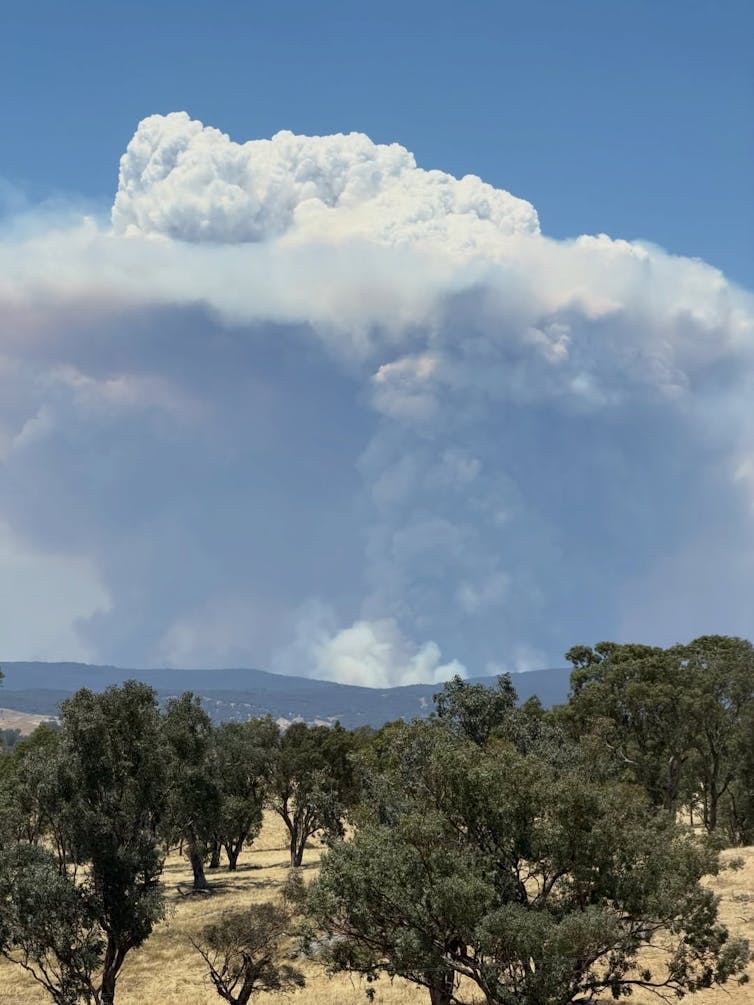
One of the most striking examples of this phenomenon is the formation of pyrocumulonimbus clouds — towering storm clouds born from fire.

How can a fire make winds and clouds?

Large bushfires release enormous amounts of energy – sometimes comparable to that emitted from a nuclear bomb. This heats the air in the vicinity of the fire, causing it to rise rapidly in a powerful, buoyant, fire-driven updraft.

Surrounding air rushes in at ground level to replace the rising hot air, feeding the fire with oxygen like a bellows and sometimes accelerating its spread. In extreme cases, the fire and its induced winds can become a self-sustaining system, feeding and growing from the weather it creates.

If the plume rises high enough it can cool to a temperature where the water vapour in the plume will begin to condense into clouds. This is essentially the same process that leads to the formation of ordinary cumulus clouds, except it occurs within a fire’s plume and is called pyrocumulus.

figure showing different types of cloud.
The classic types of cloud. Pyrocumulus and pyrocumulonimbus are much like their ordinary namesakes, but generated by fire. Valentin de Bruyn/Wikimedia, CC BY-NC-ND

Fire-generated thunderstorms

If the fire is large and intense enough, the plume can keep rising. As the cloud rises above altitudes of around 3–5 kilometres, temperatures can drop well below freezing. Water droplets freeze into ice crystals, releasing another burst of latent heat that further energises the rising plume.

The rapidly rising plume now contains ice and supercooled water — a mixture that is key to thunderstorm-like processes. It is through this process that a fire-generated thunderstorm is born, a pyrocumulonimbus cloud.

Pyrocumulonimbus clouds can reach altitudes of 10–15 kilometres, penetrating the stratosphere.

A pyrocumulus grows over the Mount Lawson fire.
A pyrocumulus grows over the Mount Lawson fire. Satchandcogallery/Facebook

Inside them, strong vertical motions generate turbulence, with ice and water droplets colliding and causing the separation of electrical charges. This can result in lightning, often striking far from the original fire front and in some cases igniting new fires.

These clouds can rise so high that they leave a clear signature visible by satellite, including a long shadow cast over the rest of the cloud and smoke. The first pyrocumulonimbus for this summer may have happened yesterday near the border of NSW and Victoria.

Lightning was detected nearby but this was among lightning occurring in many places across the Southeast states, so it may have just been pyrocumulus clouds, which can still present a significant threat. For example, the deadly 2019 Jingellic fire, which produced tornadic winds, developed a towering pyrocumulus but not a pyrocumulonimbus.

The strong updrafts created by pyrocumulonimbus can cause gusty conditions accelerating fire spread and making it less predictable. The storm can produce a strong updraft bringing fresh air in underneath to the fire, while flinging burning embers over 40km potentially creating new fires. At the same time, strong downdrafts created by the storm can flatten trees and create dangerous conditions for firefighters.

When does this happen?

Not every bushfire spawns its own weather. Pyrocumulonimbus formation requires a delicate balance between the size and intensity of the fire and the stability of the atmosphere.

Firstly, the fire must be large and intense enough to release massive amounts of heat. Secondly, the surrounding atmosphere needs to be suitably conducive to vertical motion. Both of these together allow for the plume to rise.

Satellite photo showing a plume of smoke
Smoke plumes from bushfires in Victoria, January 2025. NASA

Third, moisture in the mid-levels of the atmosphere can enhance the chances of pyrocumulonimbus formation. Moist mid-level air can get caught up in the rising plume and then add to latent heat release when it condenses and freezes, which keeps the plume rising.

The future of fire and thunder

Fire-generated thunderstorms were practically unheard of a few decades ago, but they appear to be becoming more common.

One notable example is the unprecedented number that occurred during the Black Summer of 2019–2020. Other outbreaks include around Melbourne in the Black Saturday fires of 2009 and the Canberra fires in 2003.

In all of those cases, the thunderstorms were so intense they injected smoke into stratosphere, where it circled the Earth and affected global climate patterns. Other examples of extreme weather they can cause include fire-generated tornadoes, as well as black hail in the Canberra fires.

Human-caused climate change has already caused more dangerous weather conditions for bushfires for many regions of Australia, including more dangerous conditions for fire-generated thunderstorms.

Observations show more dangerous conditions are now occurring during summer and also with an earlier start to the fire season, particularly in parts of southern and eastern Australia. These trends are very likely to increase into the future, with climate models showing more dangerous weather conditions for bushfires and fire-generated thunderstorms due to increasing greenhouse gas emissions.

Why understanding this matters

Understanding how bushfires can create their own weather is crucial for forecasting and emergency response. Traditional fire behaviour models often assume that weather drives fire, but when fires start driving weather, those models can fail.

Incorporating prediction of fire-generated clouds into fire management systems helps authorities anticipate sudden changes in fire intensity and spread. Targeted research incorporating satellite monitoring and advanced atmospheric modelling is now being used to better understand and detect conditions favourable for pyrocumulonimbus formation.

This knowledge allows for better warnings, resource allocation, and strategies to protect lives and property.

Bushfires are no longer just a local hazard — they can become atmospheric engines with global reach.The Conversation

Jason Sharples, Professor of Bushfire Dynamics, School of Science, UNSW Canberra, UNSW Sydney; Andrew Dowdy, Principal Research Scientist in Extreme Weather, The University of Melbourne; Luke Burgess, PhD Candidate, Weather and Fire Extremes, The University of Melbourne, and Todd Lane, Professor, School of Geography, Earth and Atmospheric Sciences; ARC Centre of Excellence for the Weather of the 21st Century, The University of Melbourne

This article is republished from The Conversation under a Creative Commons license. Read the original article.

Wednesday, 7 January 2026

Sentinel Owl - Monthly data for December 2025

                                                                                           Shutterstock
 
Total pageviews (all time): 674,592
December 2025 views: 37,317
Users/Countries accessing the blog:
  • Singapore: 15.8k
  • US: 8.23k
  • Brazil: 2.56k
  • India: 1.08k
  • Hong Kong: 664
  • China: 465
  • UK: 410
  • Argentina: 376
  • Mexico: 324
  • Germany: 253
  • Indonesia: 236
  • Vietnam: 168
  • Malaysia: 159
  • Netherlands: 147
  • Philippines: 125
  • Ecuador: 128