The Easter period for Christians celebrates the resurrection of Jesus from the dead, a chief tenet of their faith. It's a period of holidays, religious practices, rituals and the consumption of specific food such as hot cross buns and chocolate eggs (or chocolate rabbits/bunnies is another popular practice).
For the religious faithful, the concept of resurrection is one where, through the faith in God, followers of Jesus are resurrected spiritually and walk a new existence through eternal salvation and dwell in the Kingdom of Heaven.
The custom of Easter eggs is a symbol of life and rebirth and connected with the empty tomb upon the resurrection of Jesus. Eggs were previously chicken eggs dyed in different colours, but in recent decades took on a sweet form through the use of chocolate. In orthodox religions, dyed eggs are still the common practice.
The hot cross bun or spiced bun is made with fruit marked with a cross on the top. Traditionally eaten on Good Friday in the Christian calendar, the bun marks the commencement of the season of Lent. Parts of the bun have different meanings however the cross on the top is umistakeable as the crucifixion of Jesus. The bun has a long history stretching back to the 6th Century with variations occuring in the centuries thereafter.
May the period of Easter be one of reflection and celebration in a conflicted world.
And here’s the evidence: we’ve just experienced the 11 hottest years on record, with 2025 being the second or third warmest in global history.
The annual State of the Climate report, published today by the World Meteorological Organization, suggests we’re still too reliant on fossil fuels. And that’s pushing us further from our goal to decarbonise.
So what is happening to our climate? And how should we respond?
The climate picture
Unfortunately, the most recent climate data makes for grim reading.
Let’s look back at 2025, through the lens of four climate change indicators.
Carbon dioxide
We now have a record amount of carbon dioxide in the atmosphere, about 50% higher than pre-industrial levels. And we’re still emitting large amounts of carbon dioxide through our use of fossil fuels. In 2025, global emissions reached record high levels. The carbon dioxide we emit can stay in the atmosphere for a long time. So each year we keep emitting large amounts of carbon dioxide, the more concentrated it will be in our atmosphere.
Temperature
In 2025, the world experienced its second or third warmest year on record, depending on which dataset you use. The average temperature was about 1.43°C above the pre-industrial average.
This is particularly unusual given we observed slight La Niña conditions in the Pacific region. La Niña is a type of climate pattern characterised by temperature changes in the Pacific Ocean. It typically creates milder, wetter conditions in Australia and has a cooling effect on the global average temperature. But even with La Niña conditions, the planet stayed exceptionally hot.
And each of the last 11 years were hotter than any of the previous years in the global temperature series. This is true across all the different datasets used in the report. However, this does not mean a new record was set each year.
Oceans and ice
In 2025, the heat held within the world’s oceans reached a record high. And as our oceans continue to warm, sea levels will also rise. Hotter oceans also speed up the process of acidification, where oceans absorb an increased amount of carbon dioxide with potentially devastating consequences for some marine animals.
The amount of Arctic and Antarctic ice is also well below average. This report shows sea ice extent, a measure of how much ocean is covered by at least some sea ice, is at or close to record low levels in the Arctic. Meanwhile, the amount of ice stored in glaciers has also significantly decreased.
Extreme weather
Research shows many of the most devastating extreme weather events of 2025 were exacerbated by human-driven climate change. The heatwaves in Central Asia, wildfires in East Asia and Hurricane Melissa in the Carribean are just three examples. Through attribution analysis, which is how scientists determine the causes of an extreme weather or climate event, this report highlights how our greenhouse gas emissions are making severe weather events more common and intense.
How does Australia stack up?
Compared to most other countries, Australia has a disproportionate impact on the global climate.
This is largely because our per capita carbon dioxide emissions are about three times the global average. That means on average, each of us emits more carbon dioxide than people in all European countries and the US.
Emissions matter because they exacerbate the greenhouse effect. That is the process by which greenhouse gases, such as carbon dioxide and methane, trap heat near Earth’s surface. So by emitting more greenhouse gases, we contribute to global warming. And research suggests Earth is warming twice as fast today, compared to previous decades.
However, Australia is also experiencing first-hand the adverse effects of human-induced climate change.
In 2025, we lived through our fourth-warmest year on record. The annual surface temperatures of the seas around Australia reached historic highs, beating the record temperatures set in 2024. And last March was the hottest March we’ve seen across the continent.
The Bureau of Meteorology’s annual summary highlights how Australia’s climate is changing.
So what can we do?
The 2025 State of the Climate Report shows how much, and how quickly, we are changing our climate. And it is worryingly similar to previous reports, highlighting the need for urgent action.
The priority should be decreasing our emissions. This would slow down global warming, which will only continue if we keep the status quo. Some countries are already decarbonising rapidly, in part through transitioning to renewable electricity supplies. Others, including Australia, need to move much faster to reduce emissions.
Crucially, we must also meet our net zero targets. In Australia, as in many other countries, we are aiming to reach net zero by 2050. The sooner we reach net zero, the more likely we are to avoid harmful climate change impacts in future. To achieve net zero, we need to significantly reduce our emissions while also increasing how much carbon we remove from the atmosphere.
Even if we meet our net zero targets, climate change will not magically disappear. However, by turning away from fossil fuels and cutting our greenhouse gas emissions now, we may spare future generations from its worst effects. That’s the least we can do.
Andrew King, ARC Future Fellow and Associate Professor in Climate Science, ARC Centre of Excellence for 21st Century Weather, The University of Melbourne
One of the most immediately impacted industries from artificial intelligence (AI) is graphic design. Some images can appear as artistic creations (as shown above). Yet others can be created with a realistic appearance which is increasingly hard to detect as artificial (as shown below). Images can take only seconds to create and can be easily adjusted and edited.
Media reports, opinion editorials and speculation by public commentators about artifical intelligence (AI) have been fuelling considerable instability for the sharemarket listed ICT sector in major economies as well as concerns in the workforce regarding the actual impact of potential employment losses. The reality is that the impact of AI is not well understood or clearly defined as it is an emerging technology with the full ramifications yet to be fully measured. Most job losses and employment reductions have occured in information technology companies predominantly in the software developmnent and business support teams. This however does not represent the true extent of transformation that is coming.
A key feature of the articles and reports to date has been the under representation of actual impact as published in the media. The effect of AI has essentially been over emphasised in the technology sector and underplayed in the rest of the economy. Essentially AI will impact white collar occupations the most and be more far reaching than has been thus far reported.
Current state of play
AI is created using large language-based models and works best for rules-based, screen-based work with set parameters. Workplace transformation is already occuring in -
Knowledge work (particularly entry level)
- Administrative assistants.
- Data entry clerks
- Paralegals doing document reviews
- Junior accountants
- Basic market researchers
Content production (that is essentially formulaic)
- Copywriters for generic marketing
- SEO (search Engine Optimisers) article writers
- Basic graphic production
- Translation of common languages
These roles are not eliminated but fewer staff are needed as productivity rises.
Software roles (with a focus on junior roles)
- Junior coders
- QA testers
- Routine debugging of software
Senior engineers remain current however the career ladder below them is compressed and positions are reduced.
Customer interaction roles (accelerating an existing trend)
- call centre agents
- Tier-1 technology support
- Scheduling and booking staff
These roles can be reduced or be removed by use of Chatbots and AI voice agents.
This blog will be publishing a series of posts on the use of AI and its developing and continuing effect on the workforce and the economy.
The advent of artificial intelligence (AI) heralds the fourth industrial revolution, building on the three previous technology changes in the past. The AI revolution, as so termed, will bring with it a very strong reality of causing genuine employment reductions (not redeployment) and hence social dislocation. Occupations will be replaced and workforce reductions can and will occur often at lightening speed.
So what were the previous industrial revolutions ?
1st industrial revolution: essentially mechanisation of sorts such as water power, steam power and a move away from agrarian economies to mechanisation.
2nd industrial revolution: this was the era of electrification and new power sources. In turn this enabled new advances in mehanisation, the advent of the assembly line. Mass production became possible in both consumer goods and business-to-business methods such as machine tools.
3rd industrial revolution: the information economy and the internet. Computers, semiconductors and the use of automation and early stage robotics. The move from analog to digital also comes into this era.
And now the 4th industrial revolution which has heralded artifical intelligence, machine learning, quantum computing, biotechnology advances and connectivity between physical, digital and biological systems.
Why the 4th industrial revolution is so significant is the very characterisation of AI itself. The systems learn and improve on their own, make decisions and automate cognitive work. This a paradigm shift in reality and one where the end point and absolute objectives are not at all clear.
As conflict escalates following the US and Israeli attacks on Iran, and Iran’s subsequent retaliatory strikes, reports have emerged that Israel may have used laser weapons to shoot down rockets fired by Hezbollah from Lebanon.
While the reports are unconfirmed, video circulating on social media appears to show rockets being destroyed within moments of launching without visible intervention – consistent with the effect of a “directed energy weapon” such as a laser.
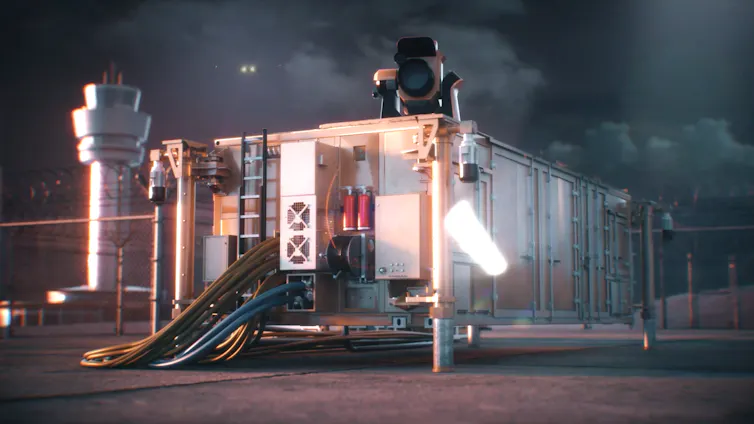
It wouldn’t be the first time Israel has used its cutting-edge Iron Beam laser air defence system, but the incident offers a glimpse into a changing landscape where high-tech militaries are scrambling to keep up with barrages of small rockets and cheap, increasingly capable drones.
What is Iron Beam?
Most defensive systems use rocket-propelled missiles against incoming threats. Iron Beam, however, uses a laser – also known as a directed energy weapon.
Where a missile destroys a drone, shell or rocket by crashing into it or exploding near it, Iron Beam destroys targets by burning them with an extremely powerful laser.
Manufactured by Rafael Advanced Defense Systems, which “serves as Israel’s High-Energy Laser National Center for Excellence and National Lethality Lab”, a smaller version of Iron Beam was first successfully tested in 2022. The system was first used in practice last year, to shoot down drones launched by Hezbollah.
How is it different to the Iron Dome, David’s Sling and Arrow air defences?
The biggest advantage of laser weapons over missiles is cost. A single Iron Dome interceptor missile costs about US$50,000 – which means the costs add up quickly when defending against large or frequent attacks.
Firing the Iron Beam laser costs a lot less. In 2022, Israel’s then prime minister Naftali Bennett said each shot cost around $US3.50, and more recent estimates suggest the cost may now have fallen as low as US$2.50 per shot.
The economics alone present a powerful motivator for militaries to develop and deploy these weapons.
Another significant advantage of Iron Beam and other directed energy weapons is that they don’t run out of ammunition. Whereas a missile battery needs to be reloaded after use, an energy weapons just needs power.
The only limiting factor for the number of shots is overheating due to the huge amounts of energy expended. Eventually a laser weapon needs to stop firing to cool down, or it will be damaged by the heat.
There’s little public information on how many shots these weapons can fire or at what rate before overheating, but it is widely assumed they can still easily outfire most conventional munitions.
Of course, Iron Beam doesn’t operate in isolation: Israel still possesses its other defensive capabilities. The cheaper Iron Beam can be used first, then backed up with other systems if needed.
The other limitation for directed energy weapons is range. They can’t reach as far as missiles such as David’s Sling or Arrow, so they are only useful for countering drones, artillery and short-range missiles.
Directed energy weapons on the ground can’t reach high-flying long-range ballistic missiles. What’s more, they are less effective in rainy, damp or cloudy conditions.
What role is Iron Beam playing in the current conflict?
Iron Beam (and other directed energy weapons being developed and deployed by other countries) are not intended to replace existing defensive systems, but to supplement them. The radically lower cost per shot provides far greater flexibility to counter “low cost” threats such as one-way drones or artillery shells.
In last year’s conflict with Iran, the United States, United Kingdom and Israel rapidly discovered they were expending large numbers of extremely expensive missiles to counter relatively cheap Iranian missiles, rockets and drones.
Directed energy weapons offer many of the same (if not greater) benefits for ground and naval-based defences.
Both the US and Israel reportedly expended a large proportion of their defensive missiles during the last conflict with Iran in 2025. Using directed energy weapons can also help preserve stores of these munitions.
Missile stockpiles are not easily replenished quickly. Even then, a large or sustained attack would quickly deplete them again.
An option that provides defence against shorter-range or slower threats allows the more expensive missiles to be held in reserve.
Where to from here?
War lasers may still sound like science fiction. But Israel is far from alone in developing and deploying them.
For naval vessels in particular the benefits of directed energy weapons are immense. Reloading defensive missiles at sea is difficult, or often impossible, requiring a return to port.
In a high-intensity conflict (or a lower-intensity but prolonged conflict) this can present a significant challenge. It can also leave vessels vulnerable when they have depleted their missile stores, or are in port to rearm.
Running out of munitions is often a significant concern for defensive systems. Directed energy weapons lessen this worry – so we are likely to see them more and more as technology develops.
The latest US-Israeli bombings in Iran differ from last year’s, because one of the stated aims this time is regime change.
Engaged in the mass murder of civilians at home and fomenting violence abroad, the current Iranian regime has few friends internationally.
Many would be glad to see Iran undergo a far-reaching program of political reform. For many in the Iranian diaspora, regime change imposed from outside is better than none.
But the historical record of imposed regime change, particularly as undertaken by the United States, is patchy at best.
Things rarely go to plan, and the long-term consequences are often disastrous.
Afghanistan and Iraq
Some immediate examples spring to mind.
Still fresh in the public mind would be the shocking scenes of desperate Afghans trying to leave Kabul in 2021 as the United States conceded it could not permanently defeat the Taliban.
This admission came after two decades, thousands of deaths of US and allied troops and tens of thousands of Afghan deaths.
Many would also remember then-US President George W. Bush’s disastrous speech in May 2003 about America’s regime change efforts in Iraq, begun in March that year. Here, Bush addressed the press while standing in front of a huge banner that said “Mission Accomplished”; the implication was regime change had been achieved in just a few months.
In fact, what followed was another decade of US fighting to try to stabilise Iraq, with actions arguably not wound up until 2018 or even beyond.
Once again this came at a huge cost to civilian lives, with The Lancet estimating as early as 2004 that around 100,000 “excess deaths” had occurred as a result of the US attempt to effect regime change there.
Thereafter, Iraq was continuously wracked by violence and civil war. Notably, ISIS took advantage of its weakened state to establish its “caliphate” on Iraqi territory, leading to yet another wave of US intervention.
But US attempts to impose regime change have a much longer and equally unsuccessful history, as well.
From the Bay of Pigs to Iran
The phrase “Bay of Pigs” has become a synonym for the inability to overthrow a government.
Aimed at overthrowing Fidel Castro in Cuba in April 1961, not only was then-US President John F. Kennedy’s foray into regime change unsuccessful (Castro died in his sleep with his regime still in control of Cuba at the age of 90 in 2016), it also led to the execution of CIA operatives there.
The US also faced the embarrassment of having to swap tractors for the freedom of the Cuban exiles who had carried out the failed invasion for them.
In 1953, the US and Britain actually did succeed in overthrowing Iranian Prime Minister Mohammad Mossadeq after he’d announced Iran’s oil industry would be nationalised in response to Western oil companies’ intransigence on royalties and control.
This regime change effort by the US did “succeed” in the short run, but it led to a series of events that culminated in the repressive regime the US aims to replace today.
Mossadeq’s toppling led to the shah of Iran, Mohammad Reza Pahlavi, becoming an absolutist monarch in the cruellest tradition.
His savage repression led in no small way to the 1979 Iranian revolution, which became the vehicle for the present theocratic government to come to power.
It is one of the ironies of history that the son of the dictatorial shah is now presenting himself as the logical candidate to bring democracy to a new Iran.
From the colonial era to WWII
Some might reach further back and argue regime change in Germany worked after the second world war.
It is worth remembering, however, that this was far from a simple process. It involved occupying Germany for more than a generation, decades of trials against ex-Nazis and splitting the country in two for more than 40 years.
As the epicentre of the Cold War, this is hardly an experiment in regime change that could be easily replicated.
Earlier examples of regime change from the colonial period provide similar lessons.
Large armies of invading colonial forces were able to pull down governments in Africa and Asia and prop up unpopular ones.
But once the occupying forces sought to remove their militaries or lost the will to resort to massacres to reinforce their rule, the shift towards decolonisation or self-rule became increasingly irresistible.
In the Dutch East Indies, French-ruled Vietnam, British India and the Belgian Congo, governments imposed by external powers were rarely viable once the threat of force was removed.
Czechoslovakia’s Prague Spring protests in 1968 – an effort to throw off Soviet-imposed rule – were quickly crushed by the USSR, showing once again that regime change “works” for as long as you are prepared to enforce it with violence.
By 1989, however, the Soviet Union’s appetite for enforcing its hegemony across eastern Europe had waned, leading to a largely peaceful transition to democracy across the region.
A failure to learn from history
Today’s US leaders are unlikely to accept the counsel of history.
But they would do well to remember the simple message of former US Secretary of State Colin Powell’s “Pottery Barn” rule for attempts to overthrow governments: you break it, you own it.
At present, however, the view from Washington seems to be that you can just break states and hope someone else will fix it for you.
The proposal envisions satellites operating between 500 and 2,000 kilometres in low Earth orbit. Some of the orbits are designed for near-constant exposure to sunlight. The public can currently submit comments on this proposal.
SpaceX’s filing is just the latest among exponentially growing satellite megaconstellation proposals. Such satellites operate with a single purpose and have short replacement life cycles of about five years.
The approval process for these satellites focuses almost entirely on the limited technical info companies have to submit to regulators.
Cultural, spiritual, and most environmental impacts aren’t taken into account – but they should be.
The night sky will drastically change
At this scale of growth, the night sky will change permanently and globally for generations to come.
Satellites in low Earth orbit reflect sunlight for about two hours after sunset and before sunrise. Despite engineering efforts to make them less bright, truck-sized satellites from many megaconstellations look like moving points in the night sky. Projections show future satellites will significantly increase this light pollution.
In 2021, astronomers estimated that in less than a decade, 1 in every 15 points of light in the night sky would be a moving satellite. That estimate only included the 65,000 megaconstellation satellites proposed at the time.
Once deployed at a scale of millions, the impacts on the night sky may not be easily reversed.
While the average satellite only lasts about five years, companies design these megaconstellations for nearly continuous replacement and expansion. This locks in a continuous, industrialised presence in the night sky.
All this is causing a space-based “shifting baseline syndrome”, where each new generation accepts a progressively more degraded night sky. Criss-crossing satellites become the new normal.
And for the first time in human history, this shifting baseline means kids today won’t grow up with the same night sky every previous generation of humanity had access to.
Industry experts also note traffic management and logistical concerns. There’s currently no form of unified space traffic management in the same way that exists in aviation, for example.
Launching so many satellites uses up vast amounts of fossil fuels, damaging the ozone layer. After the satellites have served their purpose, the end-of-life plan is to burn them up in the atmosphere. This poses another environmental concern – depositing vast quantities of metals into the stratosphere, causing ozone depletion and other potentially harmful chemical reactions.
All this feeds into legal concerns. Under international space law, countries – not companies – are liable for harm caused by their space objects.
Currently, the main regulations concerning satellite proposals are technical, such as deciding which radio frequencies they will use. At national levels, regulators focus on launch safety, lessening environmental impacts on Earth, and liability if something goes wrong.
What these regulations don’t capture is how hundreds of thousands of bright satellites change the night sky for scientific study, navigation, Indigenous teaching and ceremony, and cultural continuity.
These are not traditional “environmental” harms, nor are they technical engineering concerns. They’re cultural impacts that fall into a regulatory blind spot.
This is why the world needs a Dark Skies Impact Assessment, as proposed by space lawyers Gregory Radisic and Natalie Gillespie.
It’s a systematic way to identify, document, and meaningfully consider all the impacts of a proposed satellite constellation before it goes ahead.
How would such an assessment work?
First, evidence must be gathered from all stakeholders. Astronomers (both amateur and professional), atmospheric scientists, environmental researchers, cultural scholars, affected communities, and industry all bring their perspectives.
Third, it will define clear criteria for when unobstructed sky visibility is critical for science, navigation, education, cultural practice, and shared human heritage.
Fourth, it must include mitigation pathways such as brightness reduction, orbital design changes, and deployment adjustments to lessen harm. This should include incentives for using as few satellites as possible for a given project.
Finally, the findings must be transparent, independently reviewable, and directly tied to licensing and policy decisions.
It’s not a veto tool
A Dark Skies Impact Assessment doesn’t prevent space development. It clarifies trade-offs and improves decision making.
It can lead to design choices that reduce brightness and visual interference, orbital configurations that lessen cultural impact, earlier and more meaningful consultation, and cultural considerations where harm can’t be avoided.
Most importantly, it ensures that communities affected by satellite constellations aren’t finding out about them after approval has already been granted and bright lights crawl across their skies.
The question is not whether the night sky will change – it’s already changing. Now is the time for governments and international institutions to design fair processes before those changes become permanent.