Tuesday, 16 January 2024

The warming of Antarctica

DM Bergstrom, Author provided

A heatwave in Antarctica totally blew the minds of scientists. They set out to decipher it – and here are the results

Dana M Bergstrom, University of Wollongong

Climate scientists don’t like surprises. It means our deep understanding of how the climate works isn’t quite as complete as we need. But unfortunately, as climate change worsens, surprises and unprecedented events keep happening.

In March 2022, Antarctica experienced an extraordinary heatwave. Large swathes of East Antarctica experienced temperatures up to 40°C (72°F) above normal, shattering temperature records. It was the most intense heatwave ever recorded anywhere in the world.

So shocking and rare was the event, it blew the minds of the Antarctic climate science community. A major global research project was launched to unravel the reasons behind it and the damage it caused. A team of 54 researchers, including me, delved into the intricacies of the phenomenon. The team was led by Swiss climatologist Jonathan Wille, and involved experts from 14 countries. The collaboration resulted in two groundbreaking papers published today.

The results are alarming. But they provide scientists a deeper understanding of the links between the tropics and Antarctica – and give the global community a chance to prepare for what a warmer world may bring.

Head-hurting complexity

The papers tell a complex story that began half a world away from Antarctica. Under La Niña conditions, tropical heat near Indonesia poured into the skies above the Indian Ocean. At the same time, repeated weather troughs pulsing eastwards were generating from southern Africa. These factors combined into a late, Indian Ocean tropical cyclone season.

Between late February and late March 2022, 12 tropical storms had brewed. Five storms revved up to become tropical cyclones, and heat and moisture from some of these cyclones mashed together. A meandering jet stream picked up this air and swiftly transported it vast distances across the planet to Antarctica.

Below Australia, this jet stream also contributed to blocking the eastward passage of a high pressure system. When the tropical air collided with this so-called “blocking high”, it caused the most intense atmospheric river ever observed over East Antarctica. This propelled the tropical heat and moisture southward into the heart of the Antarctic continent.

Luck was on Antarctica’s side

The event caused the vulnerable Conger Ice Shelf to finally collapse. But the impacts were otherwise not as bad as they could have been. That’s because the heatwave struck in March, the month when Antarctica transitions to its dark, extremely cold winter. If a future heatwave arrives in summer – which is more likely under climate change – the results could be catastrophic.

Despite the heatwave, most inland temperatures stayed below zero. The spike included a new all-time temperature high of -9.4°C (15.1°F) on March 18 near Antarctica’s Concordia Research Station. To understand the immensity of this, consider that the previous March maximum temperature at this location was -27.6°C (-17.68°F). At the heatwave’s peak, 3.3 million square kilometres in East Antarctica – an area about the size of India – was affected by the heatwave.

The impacts included widespread rain and surface melt along coastal areas. But inland, the tropical moisture fell as snow – lots and lots of snow. Interestingly, the weight of the snow offset ice loss in Antarctica for the year. This delivered a temporary reprieve from Antarctica’s contribution to global sea-level rise.
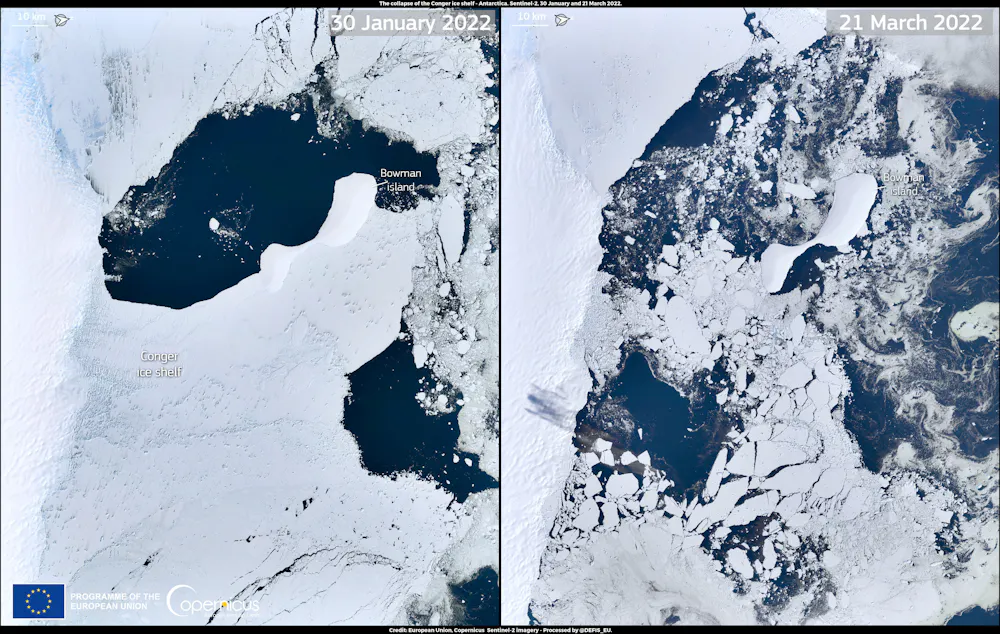
An ice shelf before (left) and after (right) a collapse.
These images, acquired by the Copernicus Sentinel-2 satellites on January 30 2022 (left) and March 21 2022 (right), show the Conger ice shelf before and after the collapse, which was triggered by a shocking heatwave. European Union, Copernicus Sentinel-2 satellite imagery, CC BY

Learning from the results

So what are the lessons here? Let’s begin with the nice bit. The study was made possible by international collaboration across Antarctica’s scientific community, including the open sharing of datasets. This collaboration is a touchstone of the Antarctic Treaty. It serves as a testament to the significance of peaceful international cooperation and should be celebrated.

Less heartwarmingly, the extraordinary heatwave shows how compounding weather events in the tropics can affect the vast Antarctic ice sheet. The heatwave further reduced the extent of sea ice, which was already at record lows. This loss of sea ice was exacerbated this year resulting in the lowest summer and winter sea ice ever recorded. It shows how disturbances in one year can compound in later years.

The event also demonstrated how tropical heat can trigger the collapse of unstable ice shelves. Floating ice shelves don’t contribute to global sea-level rise, but they acts as dams to the ice sheets behind them, which do contribute.

This research calculated that such temperature anomalies occur in Antarctica about once a century, but concluded that under climate change, they will occur more frequently.

The findings enable the global community to improve its planning for various scenarios. For example, if a heatwave of similar magnitude hit in summer, how much ice melt would there be? If an atmospheric river hit the Doomsday glacier in the West Antarctic, what rate of sea level rise would that trigger? And how can governments across the world prepare coastal communities for sea level rise greater than currently calculated?

This research contributes another piece to the complex jigsaw puzzle of climate change. And reminds us all, that delays to action on climate change will raise the price we pay.

This article has been amended to correct an error in converting a 40°C temperature difference from Celsius to Fahrenheit.The Conversation

Dana M Bergstrom, Honorary Senior Fellow, University of Wollongong

This article is republished from The Conversation under a Creative Commons license. Read the original article.

Sunday, 31 December 2023

2024 - The New Year beckons

                                                                                                                                                 Shutterstock

The start of the new year of 2024 is approaching... with a large number of unknown factors at play both domestically and internationally, it would not be surprising to find many people looking at the next 12 months with some trepidation. Serious armed conflicts in various parts of the world, increasing impacts of climate change, destabilising political movements in liberal democracies, economic uncertainties all contribute to a sense of general unease. More than ever its important to connect with each other, with friends and family to provide a measure of social network support. 

Happy New Year wherever you may reside.

Friday, 29 December 2023

Conflict in 2024


Will the world see more wars or unrest in 2024? Here are 5 hotspots to watch

Jessica Genauer, Flinders University

Sadly, 2023 has been a violent one on the global stage. War broke out between Israel and Hamas in Gaza, leading to the deaths of thousands of Palestinians and hundreds of Israelis, including many children on both sides. And the bitter war between Russia and Ukraine continued with no end in sight.

As a result of the focus on these two conflicts, other countries have dropped off the radar for many people. Some of these nations have been dealing with simmering unrest, however, which could erupt in 2024 and seize the global spotlight.

So, where should we be watching in the coming year? Here are five places where I believe civil conflicts or unrest could worsen and potentially lead to violence.

Myanmar

Myanmar descended into chaos in 2021 when a military coup overthrew the democratically elected government led by Aung San Suu Kyi and sparked widespread civil protests that eventually morphed into an armed resistance.

The country, home to 135 ethnic groups, has rarely known peace. For years before the coup, there was a ongoing, low-grade civil conflict between the military and several minority ethnic groups who have long sought control over natural resources in their regions and independence from the state.

This exploded after the coup as ethnic militia groups joined forces with pro-democracy fighters from the Bamar majority protesting the junta.

Their resistance escalated in late 2023 with a coordinated northern offensive dealing the military its most significant losses in many years.

Insurgents won control of towns and villages on the northeastern border with China, including control over key trade routes. This led to renewed fighting in western Rakhine state, as well as in other areas.

The tenacity of the resistance of these minority groups, paired with the refusal of the military to compromise, suggests the country’s civil war may worsen considerably in 2024 and regain international attention.

Mali

In Mali, a nation in the turbulent Sahel region of Africa, tensions escalated throughout 2023 and now threaten to erupt into full-scale civil war.

Mali has long battled insurgent activity. In 2012, Mali’s government fell in a coup and Tuareg rebels, backed by Islamist militants, seized power in the north.

A United Nations peacekeeping mission was established in 2013 to bring stability to Mali. Then, in 2015, key rebel groups signed a peace agreement with the Mali government.

After two more coups in 2020 and 2021, military officers consolidated their power and said they would restore the state’s full territorial control over all of Mali. The regime insisted the UN peacekeeping mission withdraw from the country, which it did in June 2023. Subsequently, violence broke out between the military and rebel forces over future use of the UN bases.

In November, the military, reportedly backed by Russia’s Wagner Group, took control of the strategic northern town of Kidal which had been held by Tuareg forces since 2012. This undermines the fragile peace that has held since 2015.

It is unlikely the military will regain complete control over all rebel-held areas in the north. At the same time, insurgents are emboldened. With the 2015 peace agreement now all but dead, we can expect increased volatility in 2024.

Lebanon

In 2019, widespread civil protest broke out in Lebanon against leaders who were perceived not to be addressing the day-to-day needs of the population.

The situation continued to deteriorate, with a reshuffled government, escalating economic crisis and a massive port explosion that exposed corrupt practices.

The International Monetary Fund criticised Lebanon in September for a lack of economic reform. The Lebanese government has also failed to reach agreement on appointing a president, a post that has been vacant for more than a year.

This risks undermining the fragile power-sharing arrangement in Lebanon in which the key political posts of prime minister, speaker and president are allocated to a Sunni-Muslim, Shia-Muslim and Christian Maronite, respectively.

Most recently, the war between Israel and Hamas has threatened to spill over to Lebanon, home to the Hezbollah militant group, which claims to have an army of 100,000 fighters. Importantly, this jeopardises tourism as a key hope for Lebanon’s economic recovery.

These factors may precipitate a more serious economic and political collapse in 2024.

Pakistan

Since Pakistan’s independence in 1947, the military has played an interventionist role in politics. Though Pakistani leaders are popularly elected, military officials have at times removed them from power.

In 2022, Pakistani Prime Minister Imran Khan fell out of favour with Pakistan’s militant leaders. He was subsequently ousted from power in a parliament vote and later arrested on charges that his supporters claim are politically motivated.

Violent demonstrations broke out nationwide after his arrest – a display of anger against the military that was once unthinkable.

Pakistan also faces spillover from instability in neighbouring Afghanistan and increased terror attacks. These security challenges have been compounded by a struggling economy and ongoing costs from the devastating 2022 floods.

Pakistan is expected to hold parliamentary elections in February 2024, after which the current military caretaker government is expected to transfer power back to civilian rule. Many are watching the military closely. If this transfer of power does not take place, or there are delays, civil unrest may result.

Sri Lanka

Sri Lanka faced a debilitating economic crisis in 2022 that led to critical fuel, food and medical shortages. Civil protests caused then-President Gotabaya Rajapaksa to flee the country. He was quickly replaced by current President Ranil Wickremesingh.

Stability returned in 2023 as Sri Lanka began implementing economic reforms as part of a bailout agreement with the International Monetary Fund. However, widespread dissatisfaction with political elites and the underlying drivers of the country’s economic hardship have not been addressed.

Elections are also due in Sri Lanka by late 2024. While Wickremesingh, the incumbent, is likely to run for a second term, he has low trust with the public. He is viewed as too close to corrupt political elites.

This dissatisfaction could lead to renewed protests – particularly if the economy stumbles again – in a repeat of the situation that led to Rajapaksa’s ousting in 2022.The Conversation

Jessica Genauer, Senior Lecturer in International Relations, Flinders University

This article is republished from The Conversation under a Creative Commons license. Read the original article.

Sunday, 24 December 2023

Christmas 2023

                                                                     Shutterstock
 
In an uncertain world with conflict, existential climate and environmental impacts and economic unknowns, it's important to find time to find some time for peace, serenity and connection with family and friends.

Seasonal greetings wherever you are and whatever your faith or beliefs. 

Wednesday, 22 November 2023

Emissions in an industrialised world - COP28

                                                                                                                 Shutterstock
 
COP28 to be held shortly in the United Arab Emirates (UAE) will open with the acceptance that the current efforts to limit greenhouse gas (GHG) emissions are well short of targets to prevent the global temperature increasing beyond 1.5C. The UAE's COP28 president has highlighted that approx 22 gigatons of GHG emissions need to be cut over the next seven years. This means a reduction of 43% in emissions from the 2019 levels that would need to be achieved by 2030. These are staggering numbers and represent the continuing failure globally to make any measurable difference thus far.

COP28 website: COP28 UAE

Wednesday, 15 November 2023

COP28 - Will meaningful action on global warming come from this forum ?


The next Council of the Parties (COP 28) for the United Nations Framework Convention on Climate Change will be held in the United Arab Emirates between 30 November and 12 December 2023. As the conference numbering suggests, this is the 28th meeting of representatives from countries around the world yet with climate change now measurably underway, how effective have the previous 27 meetings been ? And will the 28th meeting achieve more substantial progress than its predecessors ?

With a conference theme and buzzword being "actionism", the Conference promises that the first global stocktake of the implementation of the Paris Agreement will conclude at COP28 with the aim of assessing the world's collective progress towards achieving its climate goals. It may be a disappointing exercise given current global environment trends.

PFAS chemicals - a world wide contamination

Contamination of both the general environment and the human population from chemicals has long been a deep concern and for the most part, the issue has been one that can be controlled with the ''its-not-too-late" ethos. For this issue however, that ethos cannot apply.

The US Centers for Disease Control (CDC) provides the basic understanding of the scale of the problem that is now an irreversible contamination of world-wide significance. 

The CDC states " The per-and polyfluoroalkyl substances (PFAS) are a group of chemicals used to make fluoropolymer coatings and products that resist heat, oil, stains, grease and water. Fluoropolymer coatings can be in a variery of products. These include clothing, furniture, adhesives, food packaging, heat-resistant non-stick cooking surfaces, and the insulation of electrical wire. Many PFAS, including  perfluorooctanoic sulfonic acid  (PFOS) and perfluorooctanoic acid (PFOA), are a concern  because they:

  • do not break down in the environment
  • can move through soils and contaminate drinking water
  • build up (bioaccumulate) in fish and wildlife
PFAS are found in rivers and lakes and in many types of animals on land and water"

A fact sheet can be obtained at this link: CDC biomonitoring PFAS Fact Sheet

A Bloomberg video explains the issue further -

Wednesday, 8 November 2023

Antibiotics - bacterial resistance an increasing threat


The rise and fall of antibiotics. What would a post-antibiotic world look like?

Luke Jones/Unsplash
Allen Cheng, Monash University

Antimicrobial resistance is one of the biggest global threats to health, food security and development. This month, The Conversation’s experts explore how we got here and the potential solutions.


These days, we don’t think much about being able to access a course of antibiotics to head off an infection. But that wasn’t always the case – antibiotics have been available for less than a century.

Before that, patients would die of relatively trivial infections that became more serious. Some serious infections, such as those involving the heart valves, were inevitably fatal.

Other serious infections, such as tuberculosis, weren’t always fatal. Up to a half of people died within a year with the most severe forms, but some people recovered without treatment and the remainder had ongoing chronic infection that slowly ate away at the body over many years.

Once we had antibiotics, the outcomes for these infections were much better.

Life (and death) before antibiotics

You’ve probably heard of Alexander Fleming’s accidental discovery of penicillin, when fungal spores landed on a plate with bacteria left over a long weekend in 1928.

But the first patient to receive penicillin was an instructive example of the impact of treatment. In 1941, Constable Albert Alexander had a scratch on his face that had become infected.

He was hospitalised but despite various treatments, the infection progressed to involve his head. This required removing one of his eyes.

Old hospital room
In 1941, Albert Alexander was hospitalised with a severe infection. Jonathan Borba/Pexels

Howard Florey, the Australian pharmacologist then working in Oxford, was concerned penicillin could be toxic in humans. Therefore, he felt it was only ethical to give this new drug to a patient in a desperate condition.

Constable Alexander was given the available dose of penicillin. Within the first day, his condition had started to improve.

But back then, penicillin was difficult to produce. One way of extending the limited supply was to “recycle” penicillin that was excreted in the patient’s urine. Despite this, supplies ran out by the fifth day of Alexander’s treatment.

Without further treatment, the infection again took hold. Constable Alexander eventually died a month later.

We now face a world where we are potentially running out of antibiotics – not because of difficulties manufacturing them, but because they’re losing their effectiveness.

What do we use antibiotics for?

We currently use antibiotics in humans and animals for a variety of reasons. Antibiotics reduce the duration of illness and the chance of death from infection. They also prevent infections in people who are at high risk, such as patients undergoing surgery and those with weakened immune systems.

But antibiotics aren’t always used appropriately. Studies consistently show a dose or two will adequately prevent infections after surgery, but antibiotics are often continued for several days unnecessarily. And sometimes we use the wrong type of antibiotic.

Surveys have found 22% of antimicrobial use in hospitals is inappropriate.

Pharmacist looks at label on medicine box
Antibiotics are used for longer than needed and sometimes the wrong type is used. National Cancer Institute/Unsplash

In some situations, this is understandable. Infections in different body sites are usually due to different types of bacteria. When the diagnosis isn’t certain, we often err on the side of caution by giving broad spectrum antibiotics to make sure we have active treatments for all possible infections, until further information becomes available.

In other situations, there is a degree of inertia. If the patient is improving, doctors tend to simply continue the same treatment, rather than change to more appropriate choice.

In general practice, the issue of diagnostic uncertainty and therapeutic inertia are often magnified. Patients who recover after starting antibiotics don’t usually require tests or come back for review, so there is no easy way of knowing if the antibiotic was actually required.

Antibiotic prescribing can be more complex again if patients are expecting “a pill for every ill”. While doctors are generally good at educating patients when antibiotics are not likely to work (for example, for viral infections), without confirmatory tests there can always be a lingering doubt in the minds of both doctors and patients. Or sometimes the patient goes elsewhere to find a prescription.

For other infections, resistance can develop if treatments aren’t given for long enough. This is particularly the case for tuberculosis, caused by a slow growing bacterium that requires a particularly long course of antibiotics to cure.

As in humans, antibiotics are also used to prevent and treat infections in animals. However, a proportion of antibiotics are used for growth promotion. In Australia, an estimated 60% of antibiotics were used in animals between 2005-2010, despite growth-promotion being phased out.

Why is overuse a problem?

Bacteria become resistant to the effect of antibiotics through natural selection – those that survive exposure to antibiotics are the strains that have a mechanism to evade their effects.

For example, antibiotics are sometimes given to prevent recurrent urinary tract infections, but a consequence, any infection that does develop tends to be with resistant bacteria.

When resistance to the commonly used first-line antibiotics occurs, we often need to reach deeper into the bag to find other effective treatments.

Some of these last-line antibiotics are those that had been superseded because they had serious side effects or couldn’t be given conveniently as tablets.

New drugs for some bacteria have been developed, but many are much more expensive than older ones.

Treating antibiotics as a valuable resource

The concept of antibiotics as a valuable resource has led to the concept of “antimicrobial stewardship”, with programs to promote the responsible use of antibiotics. It’s a similar concept to environmental stewardship to prevent climate change and environmental degradation.

Antibiotics are a rare class of medication where treatment of one patient can potentially affect the outcome of other patients, through the transmission of antibiotic resistant bacteria. Therefore, like efforts to combat climate change, antibiotic stewardship relies on changing individual actions to benefit the broader community.

Surgeon ties her mask
Antimicrobial stewardship relies on individuals making decisions for the greater good. SJ Objio/Unsplash

Like climate change, antibiotic resistance is a complex problem when seen in a broader context. Studies have linked resistance to the values and priorities of governments such as corruption and infrastructure, including the availability of electricity and public services. This highlights that there are broader “causes of the causes”, such as public spending on sanitation and health care.

Other studies have suggested individuals need to be considered within the broader social and institutional influences on prescribing behaviour. Like all human behaviour, antibiotic prescribing is complicated, and factors like what doctors feel is “normal” prescribing, whether junior staff feel they can challenge senior doctors, and even their political views may be important.

There are also issues with the economic model for developing new antibiotics. When a new antibiotic is first approved for use, the first reaction for prescribers is not to use it, whether to ensure it retains its effectiveness or because it is often very expensive.

However, this doesn’t really encourage the development of new antibiotics, particularly when pharma research and development budgets can easily be diverted to developing drugs for conditions patients take for years, rather than a few days.

The slow moving pandemic of resistance

If we fail to act, we are looking at an almost unthinkable scenario where antibiotics no longer work and we are cast back into the dark ages of medicine – David Cameron, former UK Prime Minister

Antibiotic resistance is already a problem. Almost all infectious diseases physicians have had the dreaded call about patients with infections that were essentially untreatable, or where they had to scramble to find supplies of long-forgotten last-line antibiotics.

There are already hospitals in some parts of the world that have had to carefully consider whether it’s still viable to treat cancers, because of the high risk of infections with antibiotic-resistant bacteria.

A global study estimated that in 2019, almost 5 million deaths occurred with an infection involving antibiotic-resistant bacteria. Some 1.3 million would not have occurred if the bacteria were not resistant.

The UK’s 2014 O'Neill report predicted deaths from antimicrobial resistance could rise to 10 million deaths each year, and cost 2-3.5% of global GDP, by 2050 based on trends at that time.

What can we do about it?

There is a lot we can do to prevent antibiotic resistance. We can:

  • raise awareness that many infections will get better by themselves, and don’t necessarily need antibiotics

  • use the antibiotics we have more appropriately and for as short a time as possible, supported by co-ordinated clinical and public policy, and national oversight

  • monitor for infections due to resistant bacterial to inform control policies

  • reduce the inappropriate use of antibiotics in animals, such as growth promotion

  • reduce cross-transmission of resistant organisms in hospitals and in the community

  • prevent infections by other means, such as clean water, sanitation, hygiene and vaccines

  • continue developing new antibiotics and alternatives to antibiotics and ensure the right incentives are in place to encourage a continuous pipeline of new drugs.


Read the other articles in The Conversation’s series on the dangers of antibiotic resistance here.The Conversation

Allen Cheng, Professor of Infectious Diseases, Monash University

This article is republished from The Conversation under a Creative Commons license. Read the original article.

Saturday, 28 October 2023

Junk in Space - the crowded orbit around Earth


Space is getting crowded with satellites and space junk. How do we avoid collisions?

NASA ODPO
Sara Webb, Swinburne University of Technology; Brett Carter, RMIT University, and Christopher Fluke, Swinburne University of Technology

Reports this week suggest a near-collision between an Australian satellite and a suspected Chinese military satellite.

Meanwhile, earlier this month, the US government issued the first ever space junk fine. The Federal Communications Commission handed a US$150,000 penalty to the DISH Network, a publicly traded company providing satellite TV services.

It came as a surprise to many in the space industry, as the fine didn’t relate to any recent debris – it was issued for a communications satellite that has been in space for more than 21 years. It was EchoStar-7, which failed to meet the orbit requirements outlined in a previously agreed debris mitigation plan.

The EchoStar-7 fine might be a US first, but it probably won’t be the last. We are entering an unprecedented era of space use and can expect the number of active satellites in space to increase by 700% by the end of the decade.

As our local space gets more crowded, keeping an eye on tens of thousands of satellites and bits of space junk will only become more important. So researchers have a new field for this: space domain awareness.

Three types of orbit, plus junk

Humans have been launching satellites into space since 1957 and in the past 66 years have become rather good at it. There are currently more than 8,700 active satellites in various orbits around Earth.

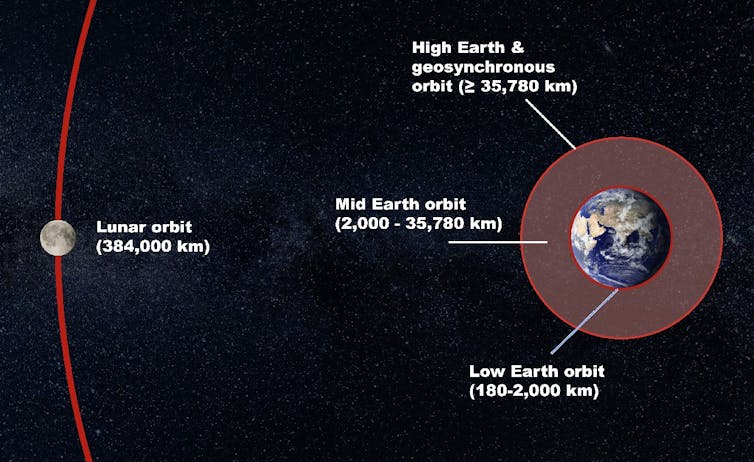
Satellites tend to be in three main orbits, and understanding these is key to understanding the complex nature of space debris.

An image of Earth with circles around it to indicate the distance of standard satellite orbits
Types of orbits around Earth classified by altitude (not to scale). Pexels/The Conversation, CC BY-SA

The most common orbit for satellites is low Earth orbit, with at least 5,900 active satellites. Objects in low Earth orbit tend to reside up to 1,000km above Earth’s surface and are constantly on the move. The International Space Station is an example of a low Earth orbit object, travelling around Earth 16 times every day.

Higher up is the medium Earth orbit, where satellites sit between 10,000 and 20,000km above Earth. It’s not a particularly busy place, but is home to some of the most important satellites ever launched – they provide us with the global positioning system or GPS.

Finally, we have very high altitude satellites in geosynchronous orbit. In this orbit, satellites are upwards of 35,000km above Earth, in orbits that match the rate of Earth’s rotation. One special type of this orbit is a geostationary Earth orbit. It lies on the same plane as Earth’s equator, making the satellites appear stationary from the ground.

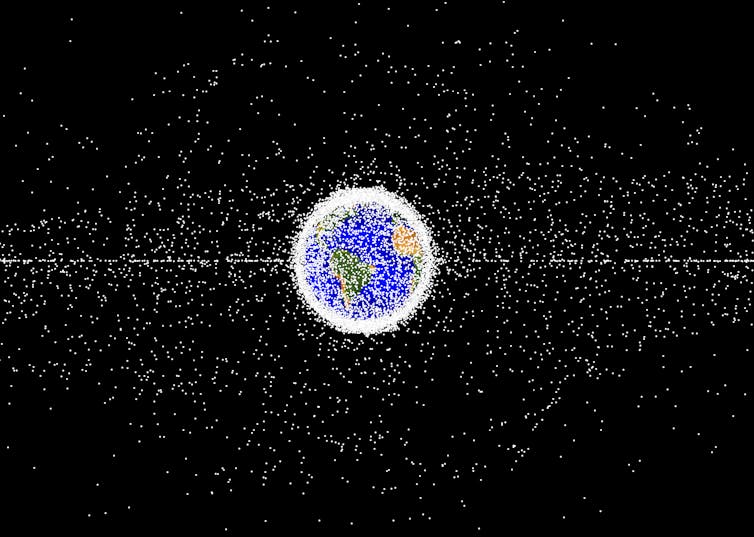
Visualisation of The European Space Agency’s Space Debris Office statistics on space debris orbiting Earth (as of January 8 2021).

As you can tell, Earth’s surrounds are buzzing with satellite activity. It only gets more chaotic when we factor in space junk, defined as disused artificial debris in orbit around Earth.

Space junk can range from entire satellites that are no longer in use or working, down to millimetre-wide bits of spacecraft and launch vehicles left in orbit. Latest estimates suggest there are more than 130 million pieces of space debris, with only 35,000 of those large enough (greater than 10cm) to be routinely tracked from the ground.

How do we track them all?

This is where space domain awareness comes in. It is the field of detecting, tracking and monitoring objects in Earth’s orbit, including active satellites and space debris.

We do much of this with ground-based tracking, either through radar or optical systems like telescopes. While radar can easily track objects in low Earth orbit, higher up we need optical sensors. Objects in medium Earth orbit and geostationary orbit can be tracked using sunlight reflected towards Earth.

For reliable and continuous space domain awareness, we need multiple sensors contributing to this around the globe.

Below you can see what high-altitude satellites can look like to telescopes on Earth, appearing to stay still as the stars move by.

Tracking two Optus satellites 16km apart, using EOS’ 0.7m deep space telescope at Learmonth, Western Australia. Source: EOS - Electro Optic Systems.

Australia’s role in space awareness

Thanks to our position on Earth, Australia has a unique opportunity to contribute to space domain awareness. The US already houses several facilities on the west coast of Australia as part of the Space Surveillance Network. That’s because on the west coast, telescopes can work in dark night skies with minimal light pollution from large cities.

Furthermore, we are currently working on a space domain awareness technology demonstrator (a proof of concept), funded by SmartSat CRC. This is a government-funded consortium of universities and other research organisations, along with industry partners such as the IT firm CGI.

We are combining our expertise in observational astrophysics, advanced data visualisation, artificial intelligence and space weather. Our goal is to have technology that understands what is happening in space minute-by-minute. Then, we can line up follow-up observations and monitor the objects in orbit. Our team is currently working on geosynchronous orbit objects, which includes active and inactive satellites.

EchoStar-7 was just one example of the fate of a retired spacecraft – the FCC is sending a strong warning to all other companies to ensure their debris mitigation plans are met.

Inactive objects in orbit could pose a collision risk to each other, leading to a rapid increase in space debris. If we want to use Earth’s space domain for as long as possible, we need to keep it safe for all.

Acknowledgment: The authors would like to thank Sholto Forbes-Spyratos, military space lead at CGI Space, Defence and Intelligence Australia, for his contribution to this article.The Conversation

Sara Webb, Postdoctoral Research Fellow, Centre for Astrophysics and Supercomputing, Swinburne University of Technology; Brett Carter, Associate Professor, RMIT University, and Christopher Fluke, SmartSat Professorial Chair, Swinburne University of Technology

This article is republished from The Conversation under a Creative Commons license. Read the original article.

Wednesday, 18 October 2023

Australia's obsession with SUVs.

Shutterstock


Where did the cars go? How heavier, costlier SUVs and utes took over Australia’s roads

Peter Martin, Crawford School of Public Policy, Australian National University

If we’re upset about the price of petrol, why do we drive the vehicles we do?

SUVs (so-called sport utility vehicles) use more fuel per kilometre than standard cars – according to the International Energy Agency, up to 25% more.

They weigh more than standard cars – about 100 kilograms more.

And they emit more carbon than standard cars. In Australia, medium-size SUVs emit 14% more carbon per kilometre travelled than medium-size cars. Large SUVs emit 30% more than large cars.

Yet we’re buying them at a rate that would have been unimaginable even a decade ago.

SUVs outsell passenger cars 3 to 1

As recently as 2012, more than half the new vehicles sold in Australia were “passenger cars” – the standard low-slung cars of the type we were used to. About one-quarter were SUVs.

Back further, in the early 1990s, three-quarters of the new vehicles we bought were passenger cars, and only 8% SUVs.

Yet after an explosion in SUV sales, today every second vehicle bought is a SUV. In September, SUVs accounted for 58% of new vehicle sales. Passenger cars accounted for just 17%. This means SUVs outsell passenger cars three to one.


Like country music, SUVs are hard to define, but you know one when you see one.

They are distinguished by being high and squarish – the words used in the official definition are “wagon body style and elevated ride height”, and generally big. They are usually four-wheel drives or all-wheel drives.

Standard passenger cars (be they hatches, sedans or wagons) sit closer to the ground, are usually lighter, and are less likely to kill or seriously injure pedestrians and cyclists, according to US insurers.

So common have the new larger SUVs become that Standards Australia is considering increasing the length of a standard parking bay by 20cm. It wants comments by November.

Also taking market share from smaller standard cars are what we in Australia call utes, which are standard vehicles (they used to be Falcons and Commodores) with a built-in tray attached at the rear.

1971 Holden Ute. Shutterstock

Utes are categorised as commercial vehicles, even though these days they tend to have four doors rather than two. They are also just as likely to be used for moving families as equipment, even if bought with small business tax concessions.

Australia’s National Transport Commission is so concerned about the rise in sales of both SUVs and utes, it warns they are “tempering Australia’s improvement in transport emissions”.

Vehicles defined as commercial, the bulk of them utes, accounted for one in five vehicles sold a decade ago. Now they are one in four, outselling passenger cars.


Tax only explains so much

Cars get special treatment in Australia’s tax system.

If an employer provides them and their private use is “minor, infrequent and irregular”, or if they are utes “not designed for the principal purpose of carrying passengers”, they can can escape the fringe benefits tax.

And from time to time small businesses get offered instant asset writeoffs, which means that all or part of the cost of the car can be written off against tax.

But apart from perhaps helping to explain the increasing preference for utes, these concessions seem insufficient to explain the demise of the standard passenger car and the rise of the expensive (and more expensive to fuel) alternatives.

Australia’s Bureau of Infrastructure and Transport Research Economics identifies the obvious: headroom, legroom and storage space, as well as the ability to drive on bad roads as well as good.

Danger is a perverse selling point

But, in an information paper, the bureau goes on to note that SUVs “appear to be more likely to kill pedestrians than cars”.

They also appear more likely to kill the occupants of standard cars than standard cars when those cars crash, largely because they are higher – a phenomenon the insurance industry refers to as “incompatibility”.

Australia’s Bureau of Infrastructure and Transport Research Economics refers to this as the “other side of the coin”.

But I think that for buyers of SUVs, it might be the same side of the coin. That is, I think it might be becoming a perverse and macabre argument for buying SUVs.

If SUVs are becoming dominant and they put other road users at risk, it makes sense not to be one of those other road users.


I am not suggesting that danger from SUVs is the only reason for the flood of buyers switching to SUVs. But I am suggesting it has helped contribute to a snowballing in demand for SUVs, along with fashion, and changed views about what’s normal.

I’m not sure what can be done at this stage. Higher petrol prices ought to have helped, but they don’t seem to have.

SUV purchases have increased, even as petrol prices have climbed. Extra taxes have been proposed to help curb road deaths, but they mightn’t help either. SUVs are already expensive.

Tighter standards would help

One thing we ought to do straight away is to shift the burden of decision-making from buyers to makers.

The federal government is about to roll out long-overdue fuel efficiency standards, of the kind already common in the rest of the world.

Ideally, those standards would require the entire fleet of vehicles sold by each manufacturer to meet a gradually-tightening average efficiency standard.

Putting more electric vehicles into each fleet would help. But so would increasing the efficiency of its conventionally-powered SUVs – which would mean reducing their weight, and with it, their danger to other people on the road.

The design of the scheme is up for grabs, and the Grattan Institute’s Marion Terrill has made a submission.

She says regardless of the switch to electric cars, Australians are going to be buying petrol and diesel vehicles for some time. That’s why it’s so important those cars become as fuel efficient (and, she could add, as safe) as they can be.The Conversation

Peter Martin, Visiting Fellow, Crawford School of Public Policy, Australian National University

This article is republished from The Conversation under a Creative Commons license. Read the original article.