Part 8 of this series on AI explored the impact of the new technology on the retail sector. This posting will further consider AI's effect on specific retail functions.
Marketing and advertsiing in retail
AI has most impact with -
Performance marketing: Google and Meta's advertising platforms are increasingly self-optimising with informed automation. The previous large teams of digital marketing specialists who managed bid strategies, audience targetting and creative testing are shrinking. The platforms can carry out the operations that previously employees would carry out.
Personalised communications: AI can and does generate individualised email, push notifications and SMS content at scale replacing or reducing human campaign teams.
Market research and consumer insight: AI can synthesise customer data, social media listening, consumjer feedback and sales patterns into insight reports thus reducing analyst headcount.
Fashion retail specifically
Fashion sits at the intersection between the retails and creative indsutries making it doubly exposed -
Trend forecasting: traditionally carried out by high-cost specialist agencies and in-house teams, AI can now analyse social media, runway coverage and sales data to predict trends with considerable accuracy.
Design assistance: Ai tools can and do generate design concepts, colourway combinations and print patterns. This places junior design assistant roles under pressure in a very cost conscious industry.
Fit and sizing: AI fit technology reduces return rates thus threatening the customer service infrastructure built around managing returns.
Wholesale and buying: the buyer role which requires relationship-building with suppliers and market intuition is more protected from AI encroachment. The analytical support underneath these roles is much less so.
At this stage AI appplication in fashion is more of an augmenting role rather than displacement of jobs but increasingly this may change.
Aliens might exist. But there are three reasons why they’re not visiting us
Steven Spielberg’s new film, Disclosure Day, explores the idea of extraterrestrial life.
UniversalCarol Oliver, UNSW Sydney
The United States government’s recent release of hundreds of previously classified Unidentified Anomalous Phenomena (UAPs) cases spanning the 1940s to the present, along with the new Steven Spielberg movie, Disclosure Day, about extraterrestrial life, has fuelled the idea that aliens are visiting Earth.
In fact, polls in Australia, the US and elsewhere indicate around a third of the public believes aliens are here.
However, while what we know about the universe suggests aliens may exist, there are three compelling reasons why they probably aren’t visiting us.
Space is big – very big
To begin with, space is vast – beyond our imagination.
Proxima Centauri, the nearest star to our Sun, is about 40 trillion kilometres away, 268,000 times farther than the Sun is from Earth. That’s 4.3 light years as astronomers measure it. A light year is the distance light travels in one year at 300,000km per second.
We can only travel across space at a fraction of the speed of light with current technology. Even our fastest spacecraft, the Parker Solar Probe, travels at a top speed of roughly 191 kilometres per second – 0.064% the speed of light.
At that speed, it would take about 6,650 years to reach Proxima Centauri, and that’s just in our local stellar neighbourhood. So interstellar travel within human lifespans would require much higher velocities.
Let’s assume we did have the means to travel close to the speed of light. That introduces the first problem with travelling at that velocity. Albert Einstein demonstrated that time is relative; the rate of time flow is not the same everywhere in the universe. The faster a spaceship travels from Earth, the slower time will pass for its passengers. This is called time dilation.
For example, when NASA astronaut Scott Kelly arrived back on Earth from a year on the International Space Station, he was milliseconds younger than his identical twin because time moves more slowly for objects in motion, and the International Space Station travels at roughly 28,150 kilometres per hour.
This difference was negligible for the Kelly twins. But for any aliens cartwheeling through our skies, it would be significantly more because of the journey to Earth and back from a distant star system at a necessarily higher speed. They would go home to a planet much older than the one they left – perhaps by a century or more. They would be time exiles.
A photograph from the Apollo 17 mission in December 1972.NASA
Unimaginably high energy requirements
Then there’s the unimaginably high energy requirement for interstellar travel.
The mass of the spaceship increases with velocity, so an increasing amount of energy is required to accelerate it.
At the speed of light, the ship becomes infinitely massive, requiring an infinite amount of energy. This is clearly impossible.
Another significant issue is that space is a vacuum – but not completely. There are just enough particles to worry about. They can potentially cause fatal radiation for passengers and the instruments of a high velocity spacecraft, or destroy it. Sparsely spread hydrogen atoms turn into intense radiation at near light speed, and the heat that is generated would ablate and eventually destroy the hull.
Faster-than-light travel, according to physicist Miguel Alcubierre, is possible, but it comes with its own set of issues and a currently impossible energy requirement.
That raises the question of why spend all this energy to travel to Earth? Anything we have, an advanced civilisation (as they would have to be to get here) would be able to make on their planet.
A unique biosphere
Yet another issue is our biosphere, unique to Earth as far as scientists know.
Life and the planet co-evolved. Complex life would not exist on Earth if cyanobacteria, a type of single-celled microbe, had not pumped oxygen into our mostly nitrogen atmosphere 2.4 billion years ago.
It’s therefore not toxic for us, but oxygen is reactive and could be highly corrosive for aliens. And while they could wear protective suits like humans do when going to inhospitable environments, reports of visiting aliens do not include any descriptions of spacesuits.
So, are aliens out there?
If aliens are not here, are they out there?
It’s an interesting question, scientifically and philosophically. Scientists do not have enough information yet, but they are working on the question.
About 6,200 exoplanets have been found in more than 4,700 solar systems, though none are like Earth or our Solar System.
Most stars could have at least one planet, and there are more than 100 billion stars in our galaxy alone. The number of planets is therefore astronomical, and some may be habitable.
Closer to home, there are worlds with potential for microbial life either past or present – Mars, Europa (a moon of Jupiter), and Enceladus and Titan (moons of Saturn). If we discover life began twice in our Solar System, that will increase the odds of life elsewhere.
Since 1960, we’ve had the capability to look for intelligence elsewhere, piggybacking on normal radio astronomy. The biggest search for alien life projects are carried out by the SETI Institute in California and the Breakthrough Listen project based at Oxford University in the United Kingdom.
Nothing has been found across all the searches made. Finding intelligence in our time frame – about a hundred years – in the 13.8-billion-year history of the universe is challenging.
However, as a 1959 Nature paper noted, while it’s difficult to estimate the chance of success, if we don’t search, the chance drops to zero.
The Sydney Film Festival (SFF) is currently running until 14 June 2026 with up to 18 separate screen venues in operation. With a mix of all genres of film and including major releases from the international film festivals, this blog will provide a series of film reviews from the SFF over coming days.
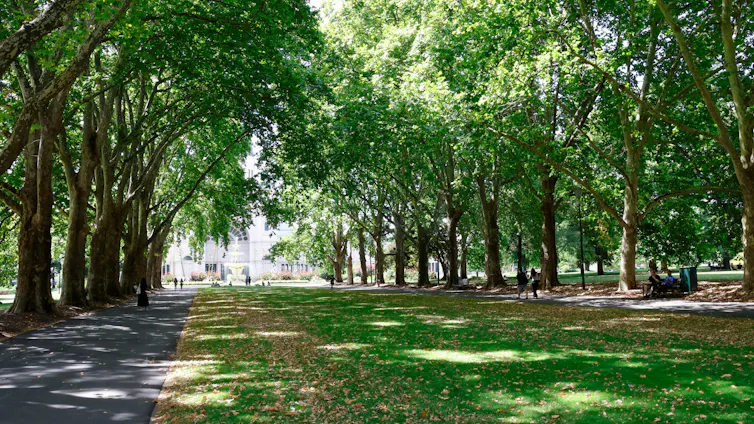
Cities around the world are planting more trees to cope with rising urban heat. But our research shows trees alone are often not enough. In some cases, the wrong kind of greening can even make streets feel less comfortable on a hot day.
We compared field measurements from Melbourne, Munich and Hong Kong to test how different kinds of urban planting changed the heat people experience outdoors.
The results showed layered vegetation – where trees are combined with shrubs and ground cover – often cooled cities more effectively than trees alone. We also found local climate and street design strongly shaped whether greening worked well.
These findings matter because urban greening is no longer just about aesthetics. As cities spend billions adapting to extreme heat, planting design may matter as much as planting quantity.
Cities are getting hotter
Cities trap heat. Roads, buildings and asphalt absorb solar energy during the day and slowly release it back into the air, especially at night.
This “urban heat island” effect, combined with climate change, is making heatwaves more intense and more dangerous in our cities.
Trees are one of the most popular responses because they provide shade and reduce the amount of heat absorbed by surrounding surfaces. But outdoor comfort depends on more than air temperature alone.
People experience heat through sunlight, reflected heat, humidity and airflow. A shaded street can still feel uncomfortable if humidity is high or if wind cannot move through the space.
That is why a “one-size fits all” greening strategy can fail. A planting design that works well in Melbourne may behave very differently in Hong Kong or Munich.
What we found
To better understand how urban vegetation affects heat stress, we did field measurements in three cities with different climates: temperate Melbourne, cooler Munich and humid subtropical Hong Kong.
Rather than relying only on computer models, we measured real conditions in streets and green spaces during summer.
We compared open urban spaces (with no plantings), sites with trees only, and layered planting (which means trees, shrubs and ground cover together).
Importantly, we did not just measure air temperature. We also measured “mean radiant temperature”, which captures the heat radiating from roads, walls and other surfaces onto the human body.
In Melbourne, street trees reduced radiant heat absorbed by pedestrians by more than 18°C, compared with open streets. Even where air temperatures changed only slightly, shaded streets felt substantially cooler.
Munich showed the strongest benefits from layered planting. There, streets and green spaces containing trees, shrubs and ground cover reduced afternoon heat stress by almost 8°C compared with more open spaces.
Hong Kong also benefited from vegetation, especially through shade created by overlapping tree canopies. But the results there were more mixed because the humid climate changed how cooling worked (more on that later).
Across all three cities, one finding stood out: vegetation structure matters.
Combining trees with shrubs and ground cover often performed better than trees alone, but the benefits depended on how the planting interacted with the local environment.
Why some greening can fail
The study showed that more vegetation is not automatically better.
In Hong Kong, dense vegetation sometimes increased humidity enough to reduce some of the cooling benefit. Plants release water vapour into the air through transpiration, which can help to cool dry climates. But in already humid cities, extra moisture can make outdoor spaces feel sticky and uncomfortable because sweat evaporates less efficiently.
In some Munich streets, dense vegetation reduced airflow through narrow urban corridors, trapping warm air and slowing the movement of vehicle pollution away from pedestrians.
These findings highlight why cities cannot rely on generic canopy targets copied from elsewhere. Climate, street width and airflow all shape whether vegetation improves comfort or creates unintended side effects.
Designing cooler cities
The solution is not to stop planting trees. It is to design urban greening more carefully.
Cities need planting strategies tailored to local conditions rather than universal greening formulas. In parks and open green spaces, layered vegetation can provide strong cooling while also supporting biodiversity. In dense streets, planners may need to balance shade with ventilation.
The findings also suggest cities should move beyond measuring success through tree numbers alone. The arrangement, density and type of vegetation matter just as much as canopy cover.
Designing for local conditions
Our research shows urban vegetation can reduce heat stress, but the benefits depend on how and where cities plant it.
Melbourne demonstrated the strong cooling effect of street trees on radiant heat, Munich showed the added value of layered vegetation, and Hong Kong revealed how dense planting can sometimes backfire in humid conditions.
Cities need climate-smart green spaces designed for local conditions, airflow and human comfort to remain liveable as temperatures rise.
The retail industry has managed several significant disruptions, particularly with technology, over many decades. Retail in this definition, spans both the physical and digital environments with multiple different segments and collectively has the highest overall level of employment. The impact of AI occurs differently across the segments as discussed below -
E-commerce and digital retail
Disruption caused by AI is most advanced in this segment of retail -
Merchanidising and product curation: AI is already used online to determine what products are shown, to which potential purchasers at what price and in which order. The human merchandiser role that once required deep product knowledge and market intuition is being replaced by AI. The result is buying teams are being reduced in headcount.
Pricing and promotions: AI can operate dynamic pricing in real timer across millions of stock keeping units (SKUs) based on demand, competitor pricing and inventory levels. The pricing analyst role has been largely automated.
Demand forecasting and inventory management: this is a large team function traditionally in retail requiring significant human judgement (which sometimes was unsuccessful with some product lines), however now AI is a dominant force. Inventory planners are increasingly deployed to exception management only.
Product descriptions, copywriting and promotional content: once the function of large copy teams for catalogues, AI now generates product listings at scale for example, at Amazon, ACOS and Zalando.
Customer service: Tier 1 customer service in e-commerce had become largely automated with chatbots and AI agents now capable of handling item returns, order queries, and complaints at scale. Human agents are increasingly handling ecalated issues only.
Searches and recommendations: the entire discovery layer of e-commerce is AI-driven thus reducing the need for manual curation teams.
Physical Retail - Shops, boutiques bricks and mortar stores
The physical retail segment has a much stronger protective layer being the embodied, social experience of shopping and the overall 'retail therapy' of personal service, expertise and the physical handling of possible items for purchase. Luxury retail, specialist retailers together with experience-led formats have led to an investment in more knowledgeable human staff. Consumers expect such interaction, expertise and better service. Retailers whom do not offer higher level services for more expensive products often find public criticism including negative consumer ratings online are the result. Nonetheless there is AI intrusion and pressure in this segment -
Checkout and payment: the increasing use of self-checkout from stores and the replacement of human checkout counters has been the proverbial thin-edge-of-the-wedge for the past two decades. For example, Amazon Go and similar checkout models eliminate checkout operator roles entirely. This process started in gocery stores but has expanded across a large part of the retail industry however not without some caveats - staff are needed to supervise and monitor self-checkout store sections, increased surveillance for fraud and theft has become essential and human operator checkout aisles have needed to be retained in smaller form.
Stock management and replenishment: computer operated vision and AI inventory systems can detect shelf gaps and product depletion thus triggering replenishment action without human stock checkers. Warehouse stock picking has increasingly become robotic.
Loss prevention: AI camera systems are increasindly replacing human loss prevention officers for monitoring and surveillance in-store. Human response to any alerts however remains essential.
In-store customer assistance: customer assistance where genuinely helpful product knowledge roles are needed means there positions are much more protected from AI encroachment. Generic customer greeting roles are much less so.
Visual merchandising: AI tools can optimise store layouts using foot traffic data and correction with sales information. This reduces the creative and analytical work of visual merchandisers.
Grocery and Fast Moving Consumer Goods (FMCG) Retail
Grocery and fast moving consumer goods is another segment when AI operates removing more of the operational back office roles. For now it cannot do the physical work of storage, presentation and despatch however systems operation is custom made for AI.
Category management: the analytical heavy lifting that category planners (planogram design, range rationalisation, promotion assessment and evaluation) are all in the process of being automated.
Supply chain coordination: AI optimises routing, supplier ordering and waste reduction. The impact is the reduction of operational planning team headcount.
Fresh food management: AI waste reduction tools are already deployed in major supermarkets. This is a direct threat to manual stock management roles but not to actual physical movement of materials.
A further post in this blog will cover other aspects of the retail industry where AI is impacting marketing, advertising and retail fashion.
Diesel is critical to Australia. Any supply disruption has immediate and widespread consequences, given Australia imports almost 80% of its liquid fuels. As the energy shocks of the Iran war ripple out, Australia’s leaders have scrambled to shore up supplies of fuel – especially diesel and aviation fuel.
Disruptions to fuel supplies have happened before, such as in 2008 and 2022. This disruption won’t be the last.
What should policymakers do? One option is to ramp up local production of biofuels made not from crude oil but from natural oils such as canola, animal fats – or algae.
As algae researchers, we believe these humble organisms are worth exploring. Making biodiesel and sustainable aviation fuel from these fast growing organisms can be done with much less land than other crops. Technological advances mean the fuel could scale up.
Many biofuels come with trade-offs
Biofuels have gained traction worldwide as efforts to reduce dependence on fossil fuels and meet climate targets accelerate.
The Australian biofuel sector is relatively small. Farmers exported about 6 million tonnes of canola in 2023–24 to be turned into biofuels overseas.
The Australian government last year announced A$1.1 billion in incentives to boost low-carbon fuels such as biofuels.
Biofuels from corn, soybean, canola and palm oil have boosted fuel security in some nations. Brazil produces 22% of its own transport fuel from biofuels, while biofuels account for 6% of the fuel used in the United States.
The problem is, biofuels often come at an environmental cost. A third of all US corn is used to make ethanol for fuel.
What’s so good about algae?
The type we’re interested in are microalgae, single-celled organisms, not macroalgae such as kelp and other types of seaweed.
These small organisms can grow exceptionally rapidly and hold high concentrations of oils. Many microalgae species can double their weight every day. Nannochloropsis and Chlorella are the two main types used to make oil.
Traditionally, algae was grown in large, shallow outdoor pools called “raceways”. They’re now increasingly grown in high-efficiency algae bioreactors.
Algae can be processed using proven technologies such as hydrothermal liquefaction to produce biodiesel able to be used in existing trucks and machinery. It can also produce sustainable aviation fuel.
Compared to crop-based biofuels, algae has several advantages. It doesn’t compete with food production and it can be grown on non-arable land or in industrial facilities. Some species can grow in saltwater or even treat wastewater while using it for growth. If algal facilities are located near heavy industry, carbon emissions can be captured and used for algal growth in a form of carbon storage.
Algal fuels needs much less land than conventional biofuels. A hectare of algae can yield more than 58,000 litres of oil per year. By contrast, a hectare of corn produces just 172 litres.
What are the barriers?
Interest in algal fuel dates back many decades. Oil shocks in the 1970s and 1990s drove significant research into algae-based fuels. But when oil prices fell, algal biofuels were no longer cost-competitive.
Since the 1990s, technologies have matured and policy settings become more favourable. Efforts to reduce fossil fuel use have put an implicit or explicit price on carbon. Mandates to increase output of sustainable aviation fuel are emerging in the European Union.
Fossil fuel price shocks in 2022 and 2026 have nudged authorities to seriously explore alternatives. Sovereign fuel security has become a strategic priority. Both the United Arab Emirates and the US are exploring algal fuels as a long-term strategic asset.
Algae for Australia?
Australia would be well placed to explore the potential of algal fuels. It has plenty of non-arable land, abundant sunlight and some of the world’s best algae research capabilities. Plus, it depends very heavily on imported diesel and aviation fuel.
Our research group and many others have been systematically working to overcome previous limitations of algal biofuels. We now know how to produce high-quality algal fuels and scale up production at costs low enough to challenge fuels derived from crude oil.
The first step would be to invest in pilot projects to prove the technology can work at scale under real-world conditions. Overseas, similar pilots have been set up next to industry to test the use of carbon capture, or alongside research partners.
If this is successful, the next step would be to build facilities in regional locations where fossil diesel is in demand and expensive to transport – and where algae can offer a dual benefit by treating wastewater or capturing carbon.
Over time, the versatile technology could be expanded, as algae can produce not only biodiesel but also other useful products such as edible protein for animal feed and biochar, highly porous charcoal able to soak up pollutants such as heavy metals.
Researchers have been working to boost yields and scale up oil production from algae.mayaluana, CC BY-NC-ND
Algae deserves our attention
Many previous efforts to scale up biofuels have run into problems over environmental impact or cost.
It’s important to be sceptical of claims of the next big thing. But it’s also important not to overlook the potential of humble technologies such as making fuel from algae.
As leaders look for ways to bolster fuel security, algae deserves a closer look.
The impact of artificial intelligence on governance and risk management is nuanced. There are some tasks that AI can do, but other functions must be undertaken by human beings. As a general description of work functions, governance teams usually produce documentation such as board briefing papers, governance reports, policy updates, compliance documentation and meeting summariess. These are all processes open to AI. This posting will provide an indication of changes coming to roles in corporate governance and risk management due to AI.
Corporate Governance
Board reporting and briefing papers preparation: AI can synthesise management informaiton, financial data and identify risks into baord-ready material reducing the administrative teams that currently do this work.
Corporate secretariat functions: the various documents produced such as records of minutes, compliance tracking, regulatory filings are all highly structured functions that are automatable and suited to AI.
ESG reporting: Environmental, Social and Governance (ESG) reporting requirements have increased in recent years creating an additional compliance burden. AI can offset the increase through tools that aggregate and report sustainability data.
Risk Management
Credit risk modelling: Credit risk modelling is a heavily quantitative task suited to AI thus reducing the analyst layers that do the manual model running and reporting.
Operational risk assessment: risk assessment identifies and quantifies risk across various buinsess processes. The assessment often produces a risk assessment table which rates and grades the risk including mitigation method. These processes are suited to be augmented by AI at the data gathering and first-analysis stage.
Market risk monitoring: real-time AI surveillance is replacing/reducing some human monitor headcounts for this task.
Compliance and regulation
KYC (Know Your Customer) and Anti-Money Laundering (AML): AI is transforming these tasks from labour-intensive manual processes to AI-monitored exception-handling workflows. The impact is the reduction in the size of large compliance teams.
Regulatory change management: the tracking and interpreting of new regulations can be augmented by AI for monitoring and summarising only. The interpretation of ambiguous regulatory language remains an essential human function not AI.
Audit: the largest 4 accounting firms are deploying AI to analyse entire transation populations rather than the traditional scope of only sampling. This change provides a better quality audit but it requires fewer junior auditors.
Prudential Regulation (Central Banks and Regulators)
Supervisory data anlysis: regulators such as APRA (in Australia), FCA (US) and Central Banks are using AI to monitor systemic risk across institutional data.
Examination and inspection of institutions: the inspection teams face efficiency improvements and possibly headcount pressure.
Policy and rule-making: roles in these functions are more protected however the judgement and accountability requires is high for human decision making.
In terms of employment, senior risk professionals are still needed for a range of actions such as - determining acceptable risk levels, advising executives on risk management, assessing complex of emerging risks, balancing regulatory, financial and reputational considerations.
Physical inspection teams are still needed and remain human-based for purposes such as: construction safety inspections, infrastructure maintenance checks, environmental site visits, equipment integrity inspections.
In the future, the workforce changes are more likely to be a reduction in the entry-level and junior operational roles with a structure as shown -
Before Chief risk/governance officer
Senior specialists
Large analyst and reporting teams
After
Chief risk/governance officer
Senior specialists (fewer)
Small team supervising AI monitoring systems
The AI systems in use include: Microsoft Copilot, IBM Watson, Palantir Technologies and SAS Institute.