Tuesday, 24 November 2026

Environment - Climate Change - COP31 failure

The COP31 conference held in Turkiye has ended without reaching a final agreement. This article below outlines the reasons for this very poor outcome.

How did the COP31 climate agreement fall apart – and what happens now?
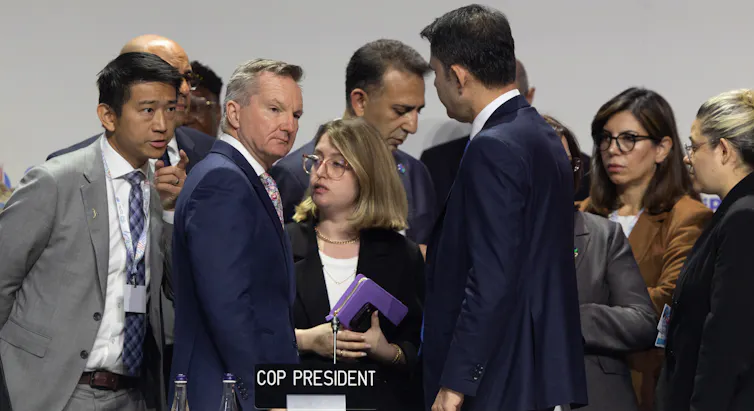
A group of people stand on the COP31 climate conference stage talking with each other.
Chris McGrath/Getty
Jacqueline Peel, The University of Melbourne and Kathryn Bowen, The University of Melbourne

Two days after the COP31 global climate summit was supposed to finish, the talks in Antalya, Turkey, have come to an end – but not as we might have hoped.

Agreement simply could not be reached. The sticking point was the omission of fossil fuels in draft texts. The European Union led a revolt, shattering the consensus needed to adopt the cover text proposed by the Turkish and Australian conveners.

In a year of unprecedented climate disasters, a supercharged El Niño and as the world heads inevitably past 1.5 °C of warming, the EU and other nations said that the international process did not meet the moment.

Some coverage has suggested the rejection of the cover text is a sign the entire summit was a failure. This isn’t quite right.

These texts have always been add-ons to the formal negotiation process. Countries have regularly agreed these political, overarching statements, particularly since the Glasgow meeting in 2021, but they are not a requirement.

Its failure does not signal the end of the COP process – or the breakdown of the Paris Agreement. What it may mean is that international climate cooperation will look different from this point onwards.
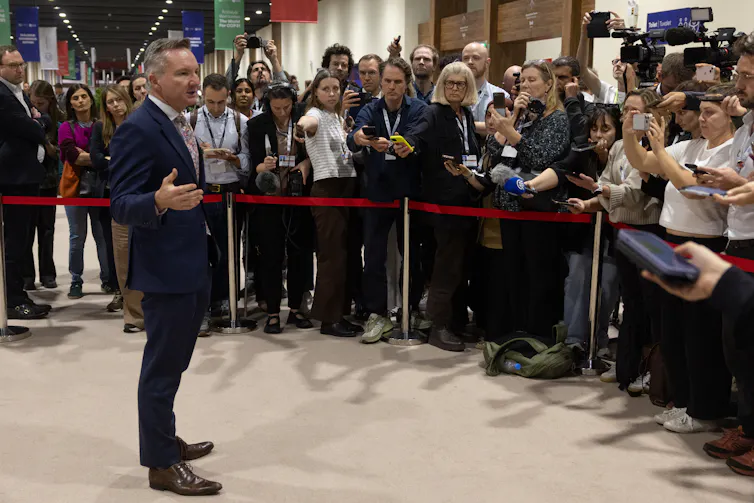
A man in a suit talks to a group of media, who are standing behind a barrier.
Chris Bowen, the COP31 president of negotiations and Australia’s Minister for Climate Change, speaks to the media after the final session during the second overtime day of the climate talks. Chris McGrath/Getty

No mention of the ‘F’ word

For many observers, the litmus test for success at COP31 was whether countries could make any headway on the root cause of climate change – fossil fuels. Unfortunately, fossil fuels proved unmentionable.

Three years ago at COP28 in Dubai, countries agreed to “transition away from fossil fuels”, marking the first time fossil fuels had explicitly been mentioned in an official decision text in decades of negotiations.

The Dubai text was hailed as “the beginning of the end of the fossil fuel era”. But there was little sign that hope would be realised in Turkey.

In a repeat of last year’s fraught negotiations at COP30 in Brazil, major fossil fuel producing nations Saudi Arabia and Russia banded together to block any reference in the negotiating outcomes and proposed cover text.

Australia and Turkey proposed a compromise – no fossil fuel language in exchange for support for electrification “with the greatest possible use of clean energy”.

This seemed to get Saudi Arabia over the line but drew backlash from the European Union, Panama, the Marshall Islands, Vanuatu, and Belize, who rejected the cover text.

Brazil took a different approach to the same problem last year. In a bid to break the deadlock, Brazil committed to develop a global strategy to phase out fossil fuels outside the formal negotiating agenda.

The roadmap was launched at this year’s summit in Turkey and managed to attract support from big fossil fuel producers such as India, Germany and Nigeria. Countries across the European Union are launching similar roadmaps.

Frustration over fossil fuels at COP31 is likely to lead more nations to go outside official talks to progress phase-out efforts. Earlier this year, 57 nations attended the first conference on transitioning away from fossil fuels in Santa Marta, Colombia. Another meeting is planned for next year, co-hosted by Tuvalu and Ireland.

Neither the Turkish hosts nor their Australian partners seemed keen to mention fossil fuels. Turkish President Recep Tayyip Erdoğan was untroubled by the optics of announcing two huge new oilfields in Turkey in his speech at the summit opening. While Australian Prime Minister Anthony Albanese highlighted the existential risks to Pacific countries from climate change, he made no commitment to stop approving new Australian coal and gas projects.

Both leaders much preferred to talk about electrification, namely the flagship “35 by 35” electrification pledge. The goal here is to boost electricity’s share of final energy use globally from around 23% at present to 35% by 2035.

Efforts to embed this goal in the cover text failed. But the electrification pledge drew strong support outside official negotiations. More than 75 countries and 180 businesses signed on, including the European Union and China.
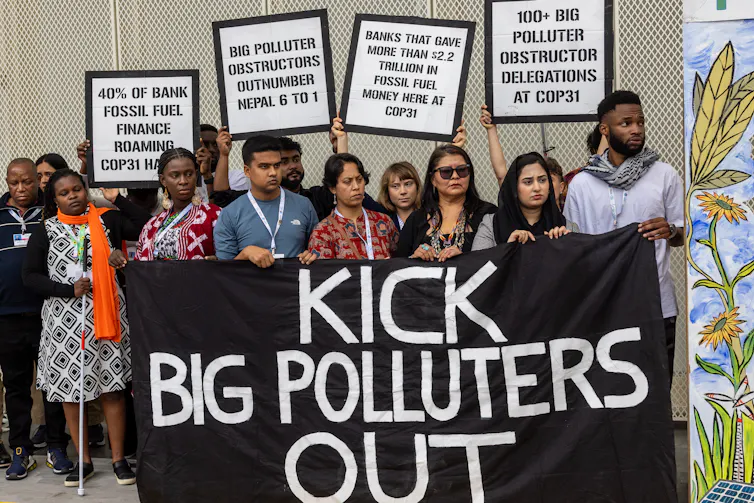
A group of protestors stand with signs that say 'Kick big polluters out'.
Activist Greta Thunberg attends a protest at the COP31 climate summit in Antalya, Turkey. Burak Kara/Getty

The “COP of action” fails to deliver

This year’s climate summit was billed as an “implementation COP”, focused on delivering the pledges countries had already made to address climate change.

Overseen by Australia in its role as “president of negotiations”, the formal talks largely focused on the actions countries are taking to reduce emissions and adapt to climate change, whether their response is sufficiently urgent and whether funds aimed at supporting the most vulnerable countries are adequate.

It was abundantly obvious that longstanding divisions had not been overcome. Developed countries called for emissions to be cut faster, while developing countries responded by pointing to a lack of financial support to do so.

African countries, in particular, stressed that an “implementation COP” was meaningless if rich nations failed to provide the actual resources needed to act.

Despite the general gloom, these talks did achieve progress in a few areas. Nations moved forwards on supporting a just transition (shifting to clean energy fairly) via a “phased approach”, as well as improving alignment in climate adaptation, which will help the poorest nations to implement their adaptation plans.

But broader efforts to find a way forward on the Paris Agreement’s Global Goal on Adaptation were left unresolved.

Decisions stalled in many negotiating rooms in the face of hard “red lines” declared by different blocs of countries.

Countries failed to reach any agreement on the vital question of cutting emissions, after Saudia Arabia and Russia blocked a proposed decision. Both are among the world’s top fossil fuel exporting nations.

This failure has left the world without any dedicated negotiating process on cutting emissions under the Paris Agreement. It’s possible nations could agree to renew a work program on climate mitigation at next year’s COP32 talks in Ethiopia.

What about money for adaptation?

Who pays for the costs of climate change has long been a contentious point. Developing countries face the brunt of damage from climate change, but have emitted far less – and have much less money to spend on adaptation.

Ahead of COP31, EU Climate Commissioner Wopke Hoekstra said talks on new climate finance commitments were “dead in the water”. He urged delegates to focus on implementing existing pledges rather than try for fresh funding.

The summit failed to meet even these low expectations. No concrete progress was achieved on the goal of tripling funds for climate adaptation pledged last year at COP30 in Brazil.

Ahead of the summit, the Australian government flagged the need to boost global contributions to the official Pacific climate fund.

This, too, didn’t eventuate. Rich nations – including Australia – merely re-announced their existing pledges, leaving the Pacific fund A$450 million short of its 2026 target of $749 million.

Ironically, the most notable pledge came from the Solomon Islands, a small Pacific nation. Prime Minister Matthew Wale pledged $600,000 to the global Green Climate Fund. “The Pacific did not create this crisis,” he declared. “But we will not stand by and wait for others to act”.

A few new commitments arrived by the end of the two week summit from nations such as Canada and Norway.

Press and participants watch as a man dressed as a dinosaur performs as part of the Fossil Of The Day award at the COP31 UN climate summit.
Press and participants watch as a man dressed as a dinosaur performs as part of the Fossil Of The Day award at the COP31 UN climate summit. Burak Kara/Getty Images

Defending the science

Unusually, climate science was front and centre at COP31.

This year, a small bloc of fossil fuel-producing countries has been obstructing the publication of key scientific reports from the world’s leading body of climate scientists, the Intergovernmental Panel on Climate Change.

This year marks the first UN summit since it was officially confirmed the world will overshoot the Paris Agreement’s 1.5°C goal by 2030.

With the collapse of support for the cover text, statements supporting release of the latest climate science didn’t get approval. All that remained were technical conclusions which “expressed utmost concern” that climate impacts will continue to increase with every increment of global warming.

A man with a white beard and hair stands at a podium in front of a blue UN and red Turkish flag.
IPCC chair Jim Skea at the opening ceremony of COP31. Previously, he described the stymied outcome of the meeting in Ethiopia as frustrating and disappointing. Chris McGrath/Getty Images

Australia on the global stage

COP31 gave Australia a unique global role. After being outmanoeuvred in their bid to host the summit, Australia secured a role in overseeing negotiations.

Australian Climate and Energy Minister Chris Bowen and his team had the unenviable task of seeking consensus between 195 countries and the European Union.

After the cover text was rejected, Bowen declared Australia had left “nothing on the field” but had faced “unbridgeable red lines.”

Hours beforehand, Fijian Climate Minister Lynda Tabuya acknowledged Bowen’s efforts, noting the failure was “not yours to carry […] it is the responsibility of all parties.”

Are COP summits still worthwhile?

This year’s climate summit took the unenviable record of the longest ever. With consensus seemingly impossible, some civil society representatives dubbed it “the worst COP ever.”

Outgoing UN Secretary-General Antonio Guterres blamed “powerful fossil fuel interests”, including fossil fuel exporters and corporate lobbyists.

Some nations are now calling for urgent reform to negotiations long paralysed by vetoes and disconnected from science.

Unfortunately, any change to official voting processes would itself require a consensus decision.

Consensus is hard to achieve, but powerful. The power of the Paris Agreement draws on the fact it represents the view of nearly every country – big or small, rich or poor.

COP31 President Murat Kurum began the summit expressing hopes this year’s talks would leave a legacy of “working together.”

That was a false hope. A more realistic hope is that the collapse of consensus may be the shock the world needs to change course.

As former UN climate chief Christiana Figueres has said, we should not see the refusal of more than 130 countries to sign an inadequate deal as a failure. Rather, it might be “a sign of courage”.The Conversation

Jacqueline Peel, Professor of Law, The University of Melbourne and Kathryn Bowen, Director, Melbourne Climate Futures and Professor - Environment, Climate and Global Health at Melbourne Climate Futures and Melbourne School of Population and Global Health, The University of Melbourne

This article is republished from The Conversation under a Creative Commons license. Read the original article.

Tuesday, 10 November 2026

Remembrance Day 2026


Remembrance Day is held on the 11th of November each year and marks the day and time that the Armistice of 1918 commenced heralding the end of the The Great War. On the 11th hour of the 11th day of the 11th month, a minute's silence is observed to commemorate not only those who fell or suffered on the distant battlefields for that conflict, but all those who have made sacrifices in all conflicts in which Australians and their allies served.

Lest we forget.

Monday, 9 November 2026

Climate Change - the lethal effect of humidity with heatwaves


Humidity can make heatwaves more dangerous. It’s time to warn Australians about this threat

storm over red dirt and highway.
Totajla/Getty
Alyson Wright, Menzies School of Health Research; Mark de Souza, The University of Melbourne, and Sharon Campbell, University of Tasmania

It’s the build-up in northern Australia – the time of year when heat and humidity get worse ahead of the wet season. Common phrases such as “going troppo” or “mango madness” give a sense of the effects. Tempers fray and tensions rise.

There’s now emerging evidence that humidity makes heat more dangerous. Humid heatwaves – where high temperatures combine with high humidity – are potentially more dangerous than dry heatwaves.

Elsewhere in the world, humid heatwaves are already claiming lives. Over 1,300 pilgrims died in Saudi Arabia in 2024 due to lethal levels of humidity and heat, while India and Pakistan have also been hard hit.

Our recent research in the Northern Territory found more people came to emergency departments during intense humid heatwaves than comparable dry heatwaves.

The problem is, we’re not warning people about this combined threat. Australia’s heatwave warning systems focus only on temperature – not on humidity.

government-issued image of a thermometer showing the risks of heat


Official warnings about heatwaves often focus on the temperature but don’t yet include humidity. Northern Territory Government

Why humidity matters

Intense heat stresses the body. Humidity can make this worse.

The human body relies heavily on sweating to regulate temperature. When sweat evaporates from the skin, it removes heat and helps keep the body cool. When humidity is high, evaporation doesn’t work as well and it’s harder for the body to release heat and stay cool.

Humid conditions can boost the risk of heat-related illnesses such as heatstroke, worsen existing heart and lung conditions and put more strain on the bodies of people with chronic diseases.

High humidity can also contribute to poor sleep, reducing the body’s ability to recover during prolonged hot periods.

Hot and wet conditions also provide optimal conditions for mosquitoes, ticks and parasites, which are vectors for the spread of key tropical diseases. Mould, bacteria and viruses are more likely to grow in high humidity, increasing the risk of lung and skin disease.

What we found in the Northern Territory

The top third of the Northern Territory has a monsoonal coastal climate prone to humidity, while the two thirds inland is arid. This means we can analyse and compare humid and dry heatwaves across these environments.

Our study analysed more than two decades of emergency department data across the NT to see if dry heat or humid heat affected the numbers of people needing emergency care. We used a temperature-based index for dry heat and a combined temperature and relative humidity index to determine humid heat.

The results were clear. While more people sought emergency treatment during both dry and humid heatwaves, humid heatwaves were worse. Severe and extreme dry heatwaves led to 4.4% more hospital visits, while similar humid heatwaves saw 6.1% more people attending emergency departments.

When arid areas of the Territory were hit by humid heatwaves, the effect was even clearer – emergency visits rose 8.7%.

Where are the warnings?

In many parts of northern Australia, heatwaves are projected to become more frequent and intense due to global warming.

Every summer, Australia’s Bureau of Meteorology issues heatwave warnings to give people advance notice of three or more days of unusual heat over day and night. Warnings can be issued for mild, severe and extreme heatwaves.

These warnings are vital. They let people prepare for heat and change plans, while health services can boost staffing numbers.

The problem is, these warnings are largely based on temperature. Most people can tolerate a 35°C day with low humidity. But a 35°C day with high humidity is much harder for us to cope with.

This means the current system may not be warning Australians about a real risk to their health – especially those in tropical and coastal regions.

Preparing health services for humid heat

Health services in the NT are often ageing and under strain. Last wet season did significant damage.

Dry and wet heatwaves will put more pressure on health systems already struggling during extreme weather. Even a modest increase in patients will add more pressure on staffing, bed capacity and resources.

We’ve long known heat affects some people much more than others. Children, older adults, people with chronic diseases and those in disadvantaged communities are hit harder. In the Territory, low-quality housing, poor access to healthcare and outdoor work and recreation also boost risks from heat.

signs pointing to a hospital and cyclone refuge.


Authorities often focus on disasters such as cyclones and floods – but humidity and heat are an often overlooked threat. BJP7images/Getty

Time to redefine heatwaves

It’s no longer enough to define a heatwave using temperature alone. Across northern Australia, humidity directly affects how people experience a heatwave.

Climatologists are already exploring ways to include humidity in measures of dangerous heat.

To take the threat of humid heat seriously, we need to redefine heatwaves to include humidity and temperature. This will strengthen our early warning systems.

On a practical level, we need to prepare our health systems for more demand during severe humid heat, particularly in remote and tropical regions.

As the Top End prepares for another wet season, authorities will focus on the threats of cyclones, flooding and other visible weather threats. It’s time to look at a less visible danger – the combination of heat and humidity.The Conversation

Alyson Wright, Adjunct Fellow in Public Health, Menzies School of Health Research; Mark de Souza, PhD Candidate in Sustainable Healthcare, The University of Melbourne, and Sharon Campbell, Postdoctoral Research Fellow in Environmental Health Research, University of Tasmania

This article is republished from The Conversation under a Creative Commons license. Read the original article.
Climate change - COP31 - Opening position for negotiations

As COP31 commences the opening tactice to enable progress with achieving a concrete outcome has been revealed by the two countries with responsibility for the Conference, Turkiye and Australia. Rather than focussing on carbon emissions reduction as the fundamental objective and target, the emphasis will be placed on increasing electrification and seeking agreement to that course of action. In effect it addresses the issue of reducing carbon emissions by using one of the methods to do so, rather than focus entirely on a carbon reduction target in itself. 

This direction is seen as reducing the likelihood of a meeting sustained opposition, particularly from petrochemical countries and therefore offering a pathway for reaching agreement from all countries. Whether this succeeds in achieving the much desired buy-in from the COP31 participants will only be apparent at the end of the Conference, when the agreed final statement is issued. 

Saturday, 7 November 2026

Climate Change - COP31 Antalya Turkiye - What is being sought at the Conference

The 31st Council of the Parties (COP) to the UN Framework Convention on Climate Change (UNFCCC) has its' next meeting commencing on 9 November and running until 20 November 2026. The host country is Turkiye with Antalya as the venue city. The main topics for discussion are -
  • Fossil fuel transition: The 2025 Summit failed to formalise any roadmap for transitioning away from fossil fuels which was a major deficiency. The COP30 Presidency of Brazil however released a voluntary roadmap ahead of COP31 this year which demonstrates a pathway for reducing fossil fuel dependence. This is critical weakness by not providing a workable process of emission reduction with a transition solution especially for countries with less capacity.
  • Reduction in emissions: the hope of many attendees to COP31 is that the Conference will accelerate carbon emission reduction but there is division of how this is best achieved. Should the Mitigation Work Program be the mechanism to drive reductions or is it merely a forum for dialogue as it has been over past years. There are also other divisions such as how to measure progress for the Global Goal on Adaptation. 
  • Climate finance: This is a thorny issue that has dogged the recent COP meetings and undoubtedly is the most contentious issue on the agenda. The Paris Agreement provided an objective for developed nations to assist with funding climate mitigation and adapation programs of developing nations. The long-running debate continues with who pays, in what form and how much. 
The COP31website link can be located here: COP31 website